NPR-KUOW joins GBOP in the field

Steve Scher from NPR-KUOW and Chris Morgan from GBOP in the field (Image: Chris Morgan)

Earlier this month Steve Scher, host of the popular NPR-KUOW radio show ‘Weekday’ joined me in the field to talk bears. Steve was piecing together a story about the bears of Washington and wanted an opportunity to learn about some of the work GBOP and our partners do on the ground. We met at Tradition Lake near Issaquah and within minutes I was able to show him some fresh bear sign! A beautiful example of a tree stump destroyed by a black bear that was searching for grubs. This forest is a great example of the quality habitat that can be found on the outskirts of a sizeable town like Issaquah, and where conflicts between bears and people can occur. These conflicts usually revolve around non-natural food attractants. A bear in a backyard is just like a dog begging at the dinner table – one reward and he’ll be back for more. The trouble is, once a bear is “food-conditioned” by tasting high-calorie foods like garbage, sunflower seeds, and compost, it is a hard habit to break. As we scoured the forest for bear clues I shared some of these thoughts with Steve who enthusiastically recorded them for his show.

Steve (right) interviews Rich Beausoleil from WDFW, and his Karelian bear dog 'Cash'. (Image: Chris Morgan)

I was excited about Steve’s approach as he was really trying to assess the future of grizzly bears and other large carnivores in Washington State. With fewer than 20 grizzly bears in the North Cascades, their future does not look bright without human intervention (an augmentation of bears from another area would be needed). In contrast, in 2008 wolves made a natural return to the Cascades for the first time in 80 years, and given half a chance, their numbers will increase along with their range. Black bears are doing pretty well in the forested ecosystems of Washington – estimates suggest there are around 20,000 in our state.

Steve checks out a grizzly bear track cast (Image: Chris Morgan)

What’s good for black bears is good for grizzly bears too, and with that in mind GBOP is always thinking about pragmatic ways for humans and bears to coexist. One of the programs we love is the work of Rich Beausoleil and Bruce Richards, both of whom are carnivore biologists with Washington Department of Fish and Wildlife. They are on the frontline of working with bears and people to ensure safety and understanding – for both species! They use Karelian bear dogs to help keep black bears (and cougars) from getting into trouble near human property. This incredible approach to wildlife management is quite something to witness so I introduced Steve to Rich and Bruce that same afternoon. He recorded the sound of a bear being released from a culvert trap with the specially trained Karelian bear dogs in hot pursuit. The recording on the radio sounds pretty dramatic to say the least, but it is all in the bear’s best interest. Instead of capturing a bear at the location where it has gotten into trouble and translocating it (only to find it later return) the new approach (made possible by the use of these dogs) is to release the bear actually right there – in the very place it is finding itself in trouble. Once the culvert trap door opens, the bear bolts out, and the crazy commotion of noise and dogs ensures that the bear will not be back for more! “Tough love” as Rich says. But it works. Steve got a real kick out of meeting Cash and Mishka, the two dogs owned by Rich and Bruce. They are among the best wildlife ambassadors out there.

Next stop was an interview with Cathy Macchio, an incredible lady who has taken it upon herself to arm her neighborhood in the Issaquah Highlands with all the information needed to live peacefully in bear habitat. She has worked tirelessly to help bears and people and we are honored to now welcome Cathy to the GBOP team.

On Monday, Steve invited Rich, Scott Fitkin (US Forest Service wildlife biologist) and myself back to the studio for a live show about bears, cougars and wolves. The show became a great overview of Washington’s carnivore heritage. You can hear the podcast here: http://www.kuow.org/program.php?id=20076

Our thanks to Steve Scher and everyone at NPR-KUOW for supporting our work by helping to spread the word!

Chris Morgan

Co-Director, GBOP

Trafficking in bear gall bladders draws fines and jail sentence

WDFW NEWS RELEASE
Washington Department of Fish and Wildlife

OLYMPIA – Investigations by Washington Department of Fish and Wildlife (WDFW) detectives into illegal trafficking in bear gall bladders have resulted in hefty fines for two eastern Washington men and a year-long jail sentence for one of them.

William A. Page, 63, a Curlew meat cutter, was sentenced Dec. 18 in Ferry County Superior Court to a year in jail plus $3,000 in fines after being convicted a month earlier of six counts of unlawful trafficking in wildlife.

Page, of 49 Bjork Ranch Rd. in Curlew, also forfeited $1,600 he paid to undercover WDFW officers for the gall bladders.

Mike Cenci, WDFW deputy chief of enforcement, said Page admitted to buying 35 gall bladders in 2007 and 2008, including 17 he purchased from undercover officers during the course of the department’s investigation.

Some people believe bear gall bladders have healing powers, Cenci said. He noted that black market prices for galls can range between $100 to thousands of dollars, depending on whether the sales take place locally or overseas.

“Buying or selling bear gall bladders is a crime in this state, because it creates an increased demand for wildlife and their body parts,” Cenci said. “That can threaten the long-term sustainability of populations that can’t withstand commercialization.”

In a separate case, the Spokane County Superior Court fined the owner of a Spokane food market $1,000 on Dec. 22 for two felony convictions of illegally trafficking in wildlife.

A Spokane jury found Jason Yon, 51, owner of JAX Market on East Mission Street, guilty of purchasing four bear gall bladders from WDFW officers during an undercover investigation in 2008. In addition to the fine, Yon forfeited $800 he paid to buy the gall bladders.

Cenci said WDFW relies heavily on tips from hunters and people in local communities about illegal wildlife-trafficking operations. He asks that people who believe they have witnessed these crimes call WDFW Enforcement at (360) 902-2936.

Grizzly Bear Safety

[toc class=”toc-right”]

Staying Safe in Bear Country

Bear attacks are very rare though many thousands of people live, work and recreate in bear country. Bears are far more likely to enhance your wilderness experience than spoil it.

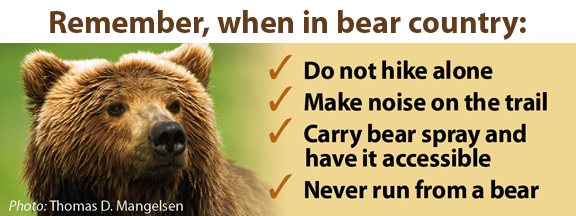
Visit our Tips for Coexistence page to learn about preventing human conflicts; remember that it is always good to be prepared for an encounter. You should always carry bear spray while recreating in bear country and know how to use it. Watch this excellent video by our  partners at Counter Assault.

https://youtu.be/pc0_GqXKETA

Remember, there is no fool-proof way of dealing with a bear encounter: each bear and encounter is different.  Knowing how to interpret their behavior and how to act responsibly is part of the pleasure of sharing our environment with wild bears.

Bear Body Language

Bears may appear tolerant of people and then attack without warning. A bear’s body language can help you determine its mood. A bear may stand on its hind legs or approach to get a better view, but these actions are not necessarily signs of aggression: the bear may not have identified you as a person and may be unable to smell or hear you from a distance.  In general, bears show agitation by swaying their heads, huffing, popping their jaws, blowing and snorting, or clacking their teeth. Lowered head and laid-back ears also indicate aggression.

Predatory vs. Defensive Bear Attacks

If you see a bear in the distance, respect the bear’s need for space.  Try to make a wide detour or leave the area. If you suddenly surprise a bear at close range, STOP. Don’t crowd the bear – leave it a clear escape route and it will probably exit. Assess the situation: is the bear acting in a calm and curious manner, or is it acting in a predatory or defensive manner?

Defensive Confrontations:

Defensive confrontations are usually the result of a sudden encounter with a bear protecting its space or food cache, and with female bears with young.   Defensive confrontations seldom lead to contact.  In defensive confrontations, the bear is threatening you because it feels threatened.

If you suddenly surprise a bear, remain calm and do not run.

  • Speak in a low monotone voice so the bear can identify you as human.
  • A bear may charge in an attempt to intimidate you – usually stopping well short of contact.
  • If a bear begins to charge, use Bear Spray as instructed under the Bear Spray section of this brochure.
  • If Bear Spray does not deter a Defensive Confrontation, drop to the ground and play dead to allow the spray to take effect. Protect your back by keeping your pack on. Lie on your stomach, clasp your hands behind your neck, and use your elbows and toes to avoid being rolled over. If the bear does roll you over, keep rolling until you land back on your stomach.
  • Remain still and quiet. A defensive bear will stop attacking once it feels the threat has been removed.
  • Do not move until you are absolutely sure the bear has left the area.

Predatory Confrontations:

Predatory attacks by bears are very rare, but do occur.  Any bear that continues to approach, follow, disappear and reappear or displays other stalking behaviors is possibly considering you as prey.  Bears that attack you in your tent or confront you aggressively in your campsite or cooking area should also be considered a predatory threat.

  • If the bear does not respond to aggressive actions such as yelling, throwing rocks and sticks, etc., you should be prepared to physically fight back if it attempts to make contact.
  • Try to be intimidating: look as large as possible.
  • If you have bear spray, emit a deterring blast, preferably before the bear is within twenty-five feet. This gives the animal time to divert its advance.
  • If the bear continue to follow, place your pack or other items down as a distraction.
  • If a grizzly bear following you, climbing a tree may be an option but it is no guarantee of safety.

From Center for Wildlife Information.

Additional Resources for Staying Safe in Bear Country

Reporting

If you have seen a grizzly bear

There are several options if you think you have seen a grizzly bear, but quick reporting is critical – please use whichever option is most convenient. If possible, please contact each of the organizations below.

  • Call the wolf-bear hotline: 1-888-WOLF-BEAR (US Fish and Wildlife Service, Olympia)
  • WA or ID Patrol or Ranger Stations (see links below)

Please be as specific as possible in your message about the location and time of the observation.

  • What exactly did you see (e.g. a single bear, family group, a grizzly bear plant dig, a carcass)?
  • Let us know if you took photographs or measurements.
  • What made you think that it was a grizzly bear or grizzly bear field sign?
  • Remember to give your full name and telephone number.

If you need to report an incident

Report all observations and field sign to your local Washington State Patrol Office, Idaho State Patrol Office, the nearest Washington ranger station or Idaho ranger station.

In case of an emergency, call 911

Visit the Products page to see our Bear Safety brochure.

A Bear Resistant Cooler that’s even Yogi Bear proof

Thousands of people go camping, fishing and recreating in bear country every year which means there is a need for bear resistant products that you can store your food/catch in.


There are bear resistant food containers, bags so you can hang your food and now there is a bear resistant cooler officially approved by the Interagency Grizzly Bear Committee. It is called the YETI.

YETI Tundra ice chests have been thoroughly tested by the Interagency Grizzly Bear Committee (IGBC) in both controlled simulations and with wild grizzly bears. The IGBC officially approved the YETI Tundra coolers for use on public lands occupied by grizzlies. The IGBC publishes minimum design and structural standards, inspection and testing methodology for BEAR RESISTANT CONTAINERS. YETI Tundra coolers met the IGBC requirement both in the engineered test and the live bear test.

The containers come in many different sizes and price ranges to meet the needs of almost anyone.

It is nice to see this new bear resistant product. Use of the YETI will help keep many bears from getting into human food which in turn will keep them from becoming problem bears.

Submitted by Wendy Gardner