PBS Special Bears of the Last Frontier Today! (7/11/2012) on KCTS 9 at 8 pm

If you missed the first opportunity,  here’s your chance! And here is what our founder, Chris Morgan, had to say on the PBS website about his experience of making this film with filmmaker Joe Pontecorvo.  To see a preview, go to http://www.pbs.org/wnet/nature/episodes/bears-of-the-last-frontier/introduction/6524/

 It’s finally here — time for us to share our incredible Alaskan adventure with the world through Bears of the Last Frontier. It has been quite the journey. The film has been nearly two years in the making, and for both of us it has become an unforgettable part of our lives. Over the course of a year and a half we traveled well over 3000 miles across Alaska and shot 500 hours of footage for this epic three-hour PBS Nature series. We spent many, many months in bear country – piecing together the lives of these fascinating animals by observing and filming them, and by living in bear country, among the animals and people that share bear habitat.

When Joe and I met nearly ten years ago (coincidentally in Alaska) our minds reeled with the possibilities for collaboration. A filmmaker and an ecologist, and a combined dream to have a huge impact for wildlife conservation through the magic of film. The opportunity to work with PBS Nature has been a dream, and has resulted in three beautiful episodes we hope you’ll love.

We’ve both worked all over the world for the last twenty plus years — Joe as an award-winning wildlife filmmaker, and me as a conservation ecologist. Joe has created dazzling films on an array of epic subjects — from tigers to Asian elephants, and my work has focused on wildlife research and environmental education — mostly about the bears of the world. I’ve also guided hundreds of people on expeditions to see polar bears and grizzly bears. We’ve both witnessed the powerful emotions that these animals can trigger in people, which is why they make such great representatives for conservation, and such great characters in film!

Alaska harbors all three of North America’s bear species, from three hundred pound black bears to polar and brown bears weighing well over half a ton. It is home to the highest mountain on the continent, vast glaciers, immense forests, and a level of isolation that can be found nowhere else in the United States.

And it’s big. This northernmost state is the same size as the next three largest states combined (California, Texas and Montana).

Alaska’s wilderness allowed us to step back in time on a journey that took us through five major ecosystems and the habitats of its three bear species. It was also a journey that put us to the test as we hiked, camped and lived among the biggest bears in the world, chased black bears through the streets of Anchorage, followed grizzlies on the prowl for immense caribou herds, and searched for polar bears miles out on the pack ice. In every one of these locations bears have adapted impressively to their surroundings.

We’re hoping that, as you wander through this website and sink yourself into the series, you will feel immersed in the world of the bear. It is a truly wondrous place.

We also hope that you might be inspired to learn more. Bears represent wildness more than any other species, but we cannot take that wildness for granted — it will take determination, passion, and imagination to ensure that future generations can enjoy a world that includes bear habitat.

Be sure to check out the wonderful organizations listed under resources for ways to learn more. We’re all in this together. And remember — what’s good for bears, is good for people!

We’re so glad you’re along for the adventure!

Chris Morgan, Ecologist
New Bear Safety Information – Yellowstone National Park

Safe travels in bear country begin before you get on the trail. Learning about bears before you go to the park can help you avoid a confrontation. Read about bear spray and what to do if you encounter a bear. When you arrive at the park, check at the nearest backcountry office or visitor center. The link below has information to help visitors travel safely in bear country. 

The information on this site can be applied in other regions that have grizzly bears, including Idaho, Washington and Montana. Know before you go! 

http://www.nps.gov/yell/planyourvisit/bearenc.htm

http://www.nps.gov/yell/photosmultimedia/bearsafety.htm

Woodland Park Zoo Bear Affair and Big Howl for Wolves, June 9, 2012

Lorna Smith, Executive Director, GBOP, and Dr. Fred Koontz, Field Conservation Director and VP of Woodland Park Zoo with the Bear Resistant Container still intact! Photo: GBOP

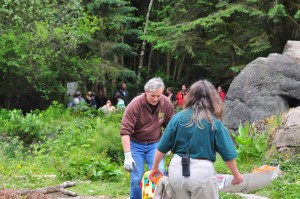
Every year, the Grizzly Bear Outreach Project teams up with Woodland Park Zoo to stage an event that is not only fun for bears and people, but helps to demonstrate some things NOT to do if you live and recreate in bear country. Zoo staff arranged the aftermath of a children’s birthday party with left-over pizza boxes and remnant birthday cake, and of course a few hotdogs strewn around. Keema and Denali, the zoo’s two 700+ pound grizzly bears, were allowed to arrive on the scene as if the human participants had all gone back inside the house and left the goodies, now available to foraging bears. 

Lorna Smith, Executive Director of GBOP, and her wildlife biologist husband Darrell Smith who volunteers for GBOP, were on hand to narrate the bear’s behavior for a fascinated audience. GBOP also had lots of visitors to their display table in the bear grotto where free “bear safety” and bear natural history information was handed out to the public. 

Ray Robertson, GBOP Field Representative and wolf expert also had a display table adjacent to the wolf enclosure. He shared some very exciting footage of Washington wolf pups, the first to be seen in the region in nearly 100 years. Thanks also to volunteers Mandy and Alan Shankle for a very professional job at the GBOP information table!

Woodland Park Zoo crew setting up the "aftermath" of a children's birthday party for the bears to bash. Photo: GBOP
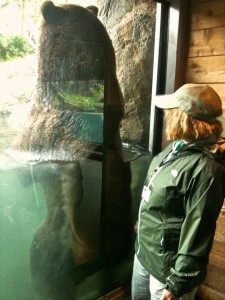
Denali in the bear pool standing upright to scratch his back on the glass, "marking" it as a bear would do in the wild. Photo: GBOP
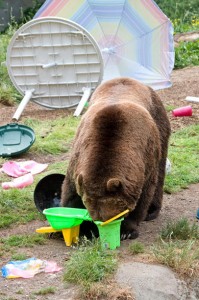
Denali looking for remnant food in a child's beach pail. Photo: Dennis Dow.


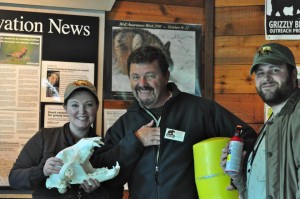
GBOP volunteers Darrell Smith, Mandy Shankle and Alan Shankle at the GBOP information table. Photo: GBOP
750 pound Keema resting after all the hard work. Photo: GBOP

$10,000 Reward Offered for Grizzly Bear Shootings in Northern Idaho.

NEWS RELEASE
US FISH AND WILDLIFE SERVICE
PACIFIC REGIONAL OFFICE

Contact: Jason Holm, 503-231-2264   Jason_holm@fws.gov
Contact Phil Cooper, 208-769-1414      Phil.Cooper@idfg.idaho.gov

$10,000 Reward Offered for Grizzly Bear Shootings in Northern Idaho.

Investigation continues in shooting of grizzly and her nursing cub.

U.S. Fish and Wildlife Service (USFWS) law enforcement agents and the Idaho Department of Fish and Game (IDFG) are investigating the fatal shooting of a federally protected grizzly bear and her nursing cub in northern Idaho. A reward of $10,000 is being offered for information leading to the identification, arrest and conviction of the person or persons responsible.  

The dead adult grizzly was discovered on the morning of May 18 by a hiker from Bonners Ferry, Idaho.  It was located in a clear-cut in Boundary County on Hall Mountain.  Hall Mountain is located east of the Kootenai River valley and northwest of US Highway 95.

The adult bear was a large female that was lactating, an indication she was nursing a cub (or cubs) produced during her recent winter hibernation. A subsequent search of the surrounding area by an Idaho Fish and Game Biologist turned up a dead cub that had also been shot.  Both bears appeared to have been dead a few days when found on May 18.

Both carcasses are being flown to the US Fish and Wildlife Service lab in Ashland Oregon for necropsy and further retrieval of evidence.

A black bear season is currently open in Idaho; however, hunters may not shoot grizzly bears and may not shoot black bears with cubs.  A bear identification program to train hunters to differentiate the species was posted last year and is available on the IDFG web page. 

Grizzly bears are classified as a threatened species in the lower 48 states and are protected by the Endangered Species Act (ESA) of 1973. Killing a threatened species protected by the ESA carries a maximum penalty of one year in prison and a $100,000 fine.

Anyone with information about this incident should contact the U.S. Fish and Wildlife Service Special Agent in Spokane, Washington, at 509-928-6050; the Idaho Department of Fish and Game at 208-769-1414; or the Idaho Citizens Against Poaching Program at 1-800-632-5999. Callers can remain anonymous.  

No additional information is being released at this time pending further investigation.

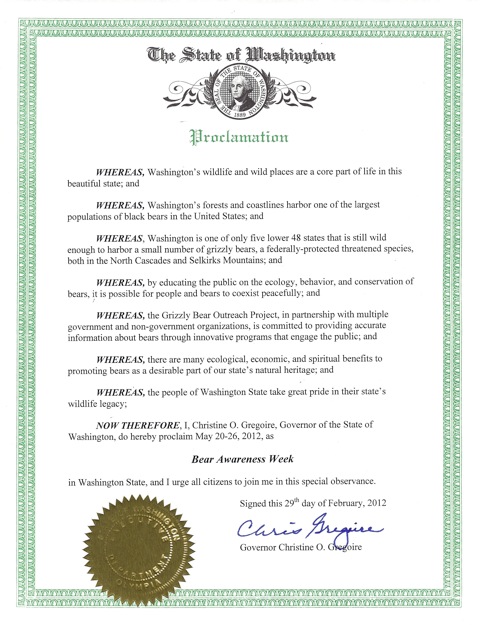
Governor Gregoire Declares May 20-26, 2012 Bear Awareness Week

Washington State’s Governor Gregoire declares May 20-26, 2012 “Bear Awareness Week”
Special resources celebrate state’s grizzly and black bears and educate the public on how to co-exist

Black bears and grizzlies are an important part of our state’s natural heritage. Today, Washington has one of the healthiest black bear populations in the U.S.  It is also one of just five states in the lower 48 still wild enough for a small number of federally-listed threatened grizzly bears.

Recognizing the value of bears and the need to educate the public on how to live and recreate safely with them, Governor Christine Gregoire recently declared May 20-26 “Bear Awareness Week.”  Among other points, the Governor’s proclamation notes, “Whereas, by educating the public on the ecology, behavior, and conservation of bears, it is possible for people and bears to coexist peacefully…”