Safe travels in bear country begin before you get on the trail. Learning about bears before you go to the park can help you avoid a confrontation. Read about bear spray and what to do if you encounter a bear. When you arrive at the park, check at the nearest backcountry office or visitor center. The link below has information to help visitors travel safely in bear country.
The information on this site can be applied in other regions that have grizzly bears, including Idaho, Washington and Montana. Know before you go!
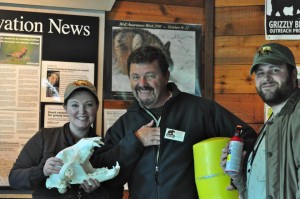
Lorna Smith, Executive Director, GBOP, and Dr. Fred Koontz, Field Conservation Director and VP of Woodland Park Zoo with the Bear Resistant Container still intact! Photo: GBOP
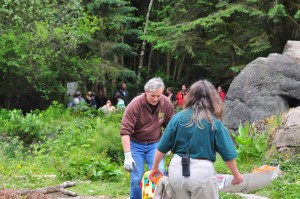
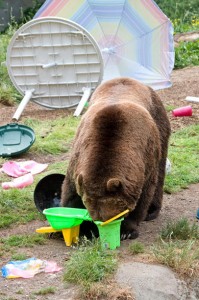
Every year, the Grizzly Bear Outreach Project teams up with Woodland Park Zoo to stage an event that is not only fun for bears and people, but helps to demonstrate some things NOT to do if you live and recreate in bear country. Zoo staff arranged the aftermath of a children’s birthday party with left-over pizza boxes and remnant birthday cake, and of course a few hotdogs strewn around. Keema and Denali, the zoo’s two 700+ pound grizzly bears, were allowed to arrive on the scene as if the human participants had all gone back inside the house and left the goodies, now available to foraging bears.
Lorna Smith, Executive Director of GBOP, and her wildlife biologist husband Darrell Smith who volunteers for GBOP, were on hand to narrate the bear’s behavior for a fascinated audience. GBOP also had lots of visitors to their display table in the bear grotto where free “bear safety” and bear natural history information was handed out to the public.
Ray Robertson, GBOP Field Representative and wolf expert also had a display table adjacent to the wolf enclosure. He shared some very exciting footage of Washington wolf pups, the first to be seen in the region in nearly 100 years. Thanks also to volunteers Mandy and Alan Shankle for a very professional job at the GBOP information table!
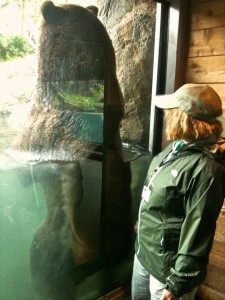
Woodland Park Zoo crew setting up the "aftermath" of a children's birthday party for the bears to bash. Photo: GBOPDenali in the bear pool standing upright to scratch his back on the glass, "marking" it as a bear would do in the wild. Photo: GBOPDenali looking for remnant food in a child's beach pail. Photo: Dennis Dow.
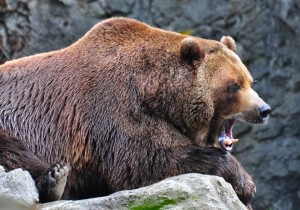
GBOP volunteers Darrell Smith, Mandy Shankle and Alan Shankle at the GBOP information table. Photo: GBOP750 pound Keema resting after all the hard work. Photo: GBOP
Cougars are an important part of our natural heritage. Sleek and graceful, cougars are solitary and secretive animals rarely seen in the wild. With neighborhoods encroaching into wildlife habitat, the number of cougar sightings may increase, but a cougar sighting does not mean that there are more in an area. The cougar’s ability to travel long distances occasionally brings these cats into seemingly inappropriate areas, even places densely settled by humans. Such appearances are almost always brief, with the animal moving along quickly in its search of a suitable permanent home.
Photo: Mark Mulligan / The Herald
The young cougar in this news article was safely trapped and removed from such a place. “She could be at an age where she’s learning to hunt on her own. Her mother likely ran her off to encourage her to establish her own territory.” Such inexperience gets some cougars into trouble, but in this case good practices in non-lethal wildlife control techniques by state wildlife agents may help assure that this cougar will have no interest in anything human. Karelian Bear Dogs, which work to deter and repel bears, are being used to conduct similar work with cougars. Read the article, look at the photo gallery, and find that even an officer many years in the field can still be deeply moved to appreciate a magnificent young cougar.
Click the link to read the HeraldNet news article:
$10,000 Reward Offered for Grizzly Bear Shootings in Northern Idaho.
Investigation continues in shooting of grizzly and her nursing cub.
U.S. Fish and Wildlife Service (USFWS) law enforcement agents and the Idaho Department of Fish and Game (IDFG) are investigating the fatal shooting of a federally protected grizzly bear and her nursing cub in northern Idaho. A reward of $10,000 is being offered for information leading to the identification, arrest and conviction of the person or persons responsible.
The dead adult grizzly was discovered on the morning of May 18 by a hiker from Bonners Ferry, Idaho. It was located in a clear-cut in Boundary County on Hall Mountain. Hall Mountain is located east of the Kootenai River valley and northwest of US Highway 95.
The adult bear was a large female that was lactating, an indication she was nursing a cub (or cubs) produced during her recent winter hibernation. A subsequent search of the surrounding area by an Idaho Fish and Game Biologist turned up a dead cub that had also been shot. Both bears appeared to have been dead a few days when found on May 18.
Both carcasses are being flown to the US Fish and Wildlife Service lab in Ashland Oregon for necropsy and further retrieval of evidence.
A black bear season is currently open in Idaho; however, hunters may not shoot grizzly bears and may not shoot black bears with cubs. A bear identification program to train hunters to differentiate the species was posted last year and is available on the IDFG web page.
Grizzly bears are classified as a threatened species in the lower 48 states and are protected by the Endangered Species Act (ESA) of 1973. Killing a threatened species protected by the ESA carries a maximum penalty of one year in prison and a $100,000 fine.
Anyone with information about this incident should contact the U.S. Fish and Wildlife Service Special Agent in Spokane, Washington, at 509-928-6050; the Idaho Department of Fish and Game at 208-769-1414; or the Idaho Citizens Against Poaching Program at 1-800-632-5999. Callers can remain anonymous.
No additional information is being released at this time pending further investigation.
Interview with Rose Olvier, Skagit and Whatcom County Field Coordinator for the Grizzly Bear Outreach Project, for Bellingham WA’s Co-op Community News
Hiking in the North Cascades some time in the late 1990s, I met a momma bear and her cub on the trail. They were extremely beautiful, with the sun shining through their long fur as the wind ruffled it. My response at the time, however, was to say “B-B-B- Baby Bear!” in a tone of deep distress. Then I ran rapidly back down the trail for several miles.
So when I had a chance to talk with Rose Oliver, the Skagit and Whatcom County Field Coordinator for the Grizzly Bear Outreach Project (GBOP), I asked for some pointers, in case I ever meet more bears on the trail.
“Well,” she said diplomatically, “You did do a good job putting distance between the bears and you. Generally, though, backing away slowly is much better than running.”
As their name suggests, the Grizzly Bear Outreach Project knows about bears, and about human-bear interactions. However their work has grown beyond just black bears and grizzly bears to include wolves and cougars. The organization works across the state, focusing primarily on areas where people and other large carnivores overlap. Rose provided more detail about the collective importance of those species.
“We focus on a few species we call ‘keystone species.’ If you think of an ecosystem as shaped like an arch, large predators are the keystone block in the center; they may be small in number, but without that block, the whole structure collapses. The same is true with our ecosystems.”
Specifically in the case of cougars and wolves, it is proven that when they have been removed from an ecosystem, over-browsing by deer and elk can occur, who love to eat tree saplings before they’ve had a chance to mature. However, songbirds, fish, and small mammal communities rely on these trees growing to full maturity. The presence of cougars and wolves creates more biologically diverse plant and animal communities.”
GBOP’s insistence on the importance of science reflects their mission; they’re an educational organization. They spend a lot of time meeting with businesses, individuals, park and forest service staff, as well as tabling at community events. In a region where political tensions characterize a lot of opinion about large carnivores, they describe themselves like this: “We are unique because we meet with community members and listen to their opinions, concerns, and ideas, and we partner with government agencies, non-government organizations, and the public to create wildlife-safe communities.”
Rose lives in Marblemount, not too distant from where the first confirmed North Cascades Grizzly sighting in more than a decade happened last year. Given the potential for urban/ rural divisions of opinion about bears, wolves, and cougars, I was happy to hear that the group’s field staff generally live in communities directly affected by what Rose calls “the human-wildlife interface.”
“We have field staff in Twisp, Issaquah, and along the Washington-Idaho border,” she explained. “While education is important for everyone, we really focus our work on the areas where these animals and people are sharing territory.
“It’s important to be prepared for an encounter with a bear when you’re in bear country, but it’s also important to dispel some of the common myths and misconceptions people have. For instance, you are more likely to be struck by lightning or killed in a car wreck on the way to a trailhead than attacked by a grizzly bear. All in all, bears are far more likely to enhance your wilderness experience than spoil it.”
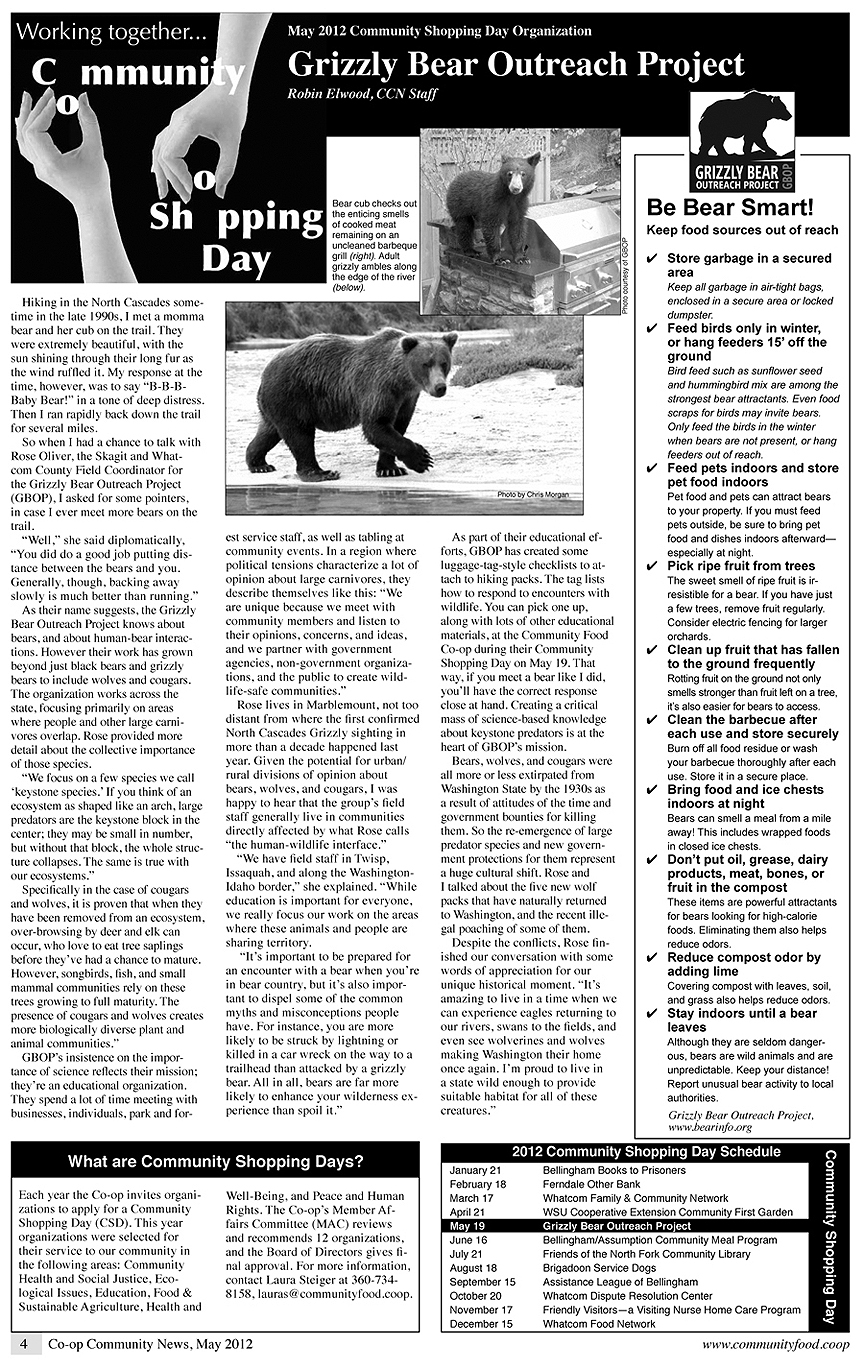
As part of their educational efforts, GBOP has created some luggage-tag-style checklists to attach to hiking packs. The tag lists how to respond to encounters with wildlife. You can pick one up, along with lots of other educational materials, at the Community Food Co-op during their Community Shopping Day on May 19. That way, if you meet a bear like I did, you’ll have the correct response close at hand. Creating a critical mass of science-based knowledge about keystone predators is at the heart of GBOP’s mission.
Bears, wolves, and cougars were all more or less extirpated from Washington State by the 1930s as a result of attitudes of the time and government bounties for killing them. So the re-emergence of large predator species and new government protections for them represent a huge cultural shift. Rose and I talked about the five new wolf packs that have naturally returned to Washington, and the recent illegal poaching of some of them.
Despite the conflicts, Rose finished our conversation with some words of appreciation for our unique historical moment. “It’s amazing to live in a time when we can experience eagles returning to our rivers, swans to the fields, and even see wolverines and wolves making Washington their home once again. I’m proud to live in a state wild enough to provide suitable habitat for all of these creatures.”
by Robin Elwood, Co-op Community News Staff
Page 4 of the Co-Op Community News and GBOP Interview with Rose Oliver