RICHARD A. BEAUSOLEIL, Bear / Cougar Specialist, Washington Department of Fish and Wildlife
Guest Post
Between 2002 and 2012, 26 orphan cougar cubs have been reported to Washington Department of Fish and Wildlife (WDFW), captured by staff, and placed with facilities accredited by the Association of Zoos and Aquariums (AZA) throughout the country (Table 1, Figure 1). In addition to over 15 million visitors per year at these facilities, innumerable television and newsprint stories have covered the capture, transport, and arrival of these animals reaching out to countless millions more people. This has not only resulted in high quality cougar educations programs benefiting people who may never have the chance to see a cougar in the wild, but also brought prominent national attention to WDFW.
The process of responding, capturing, providing care until the arrangement are finalized, and transporting animals requires organization, commitment, and on occasion, personal donations of time and money. In almost all cases, orphaned cougars are reported to WDFW by a member of the public concerned that the animals will not survive on their own. In many cases, the reports are given without the reporting party knowing the specifics; only that the kittens have been seen for some time without an adult. If it’s the first sighting, and we do not have background knowledge, we ask that they leave the animals alone and keep us posted; this avoids removing kittens that are not orphaned. Usually within few days, additional information is obtained and we are more certain that the adult is no longer present and a response is initiated. In addition to using several types of box traps, kittens have been captured using WDFW’s Karelian Bear Dogs, and also by hand on several occasions. Once captured, all kittens are tested for FeLV, transported to a veterinarian, given a thorough examination and care is administered if needed and biological measurements are gathered and recorded. Health certificates are then issued to facilitate transfer. Many times, kittens need to travel by aircraft to their final destination. Regulations require an absorbent material be used as a base layer in the crate, windows and doors be covered with breathable burlap, doors securely locked, and food and water provided. Flights are almost always direct to the destination. As much as possible, we keep the reporting party involved throughout the process; this had resulted in respect, credibility, and much appreciation. We acknowledge the assistance of Michelle Schireman, North America Section AZA Felid TAG Puma Population Manager & Regional Studbook Keeper, who has been an invaluable collaborator in placing these animals.
Table 1. Orphaned cougar kittens donated to AZA accredited organizations from Washington and annual visitation at these facilities, Washington Department of Fish and Wildlife, 2002-2012.
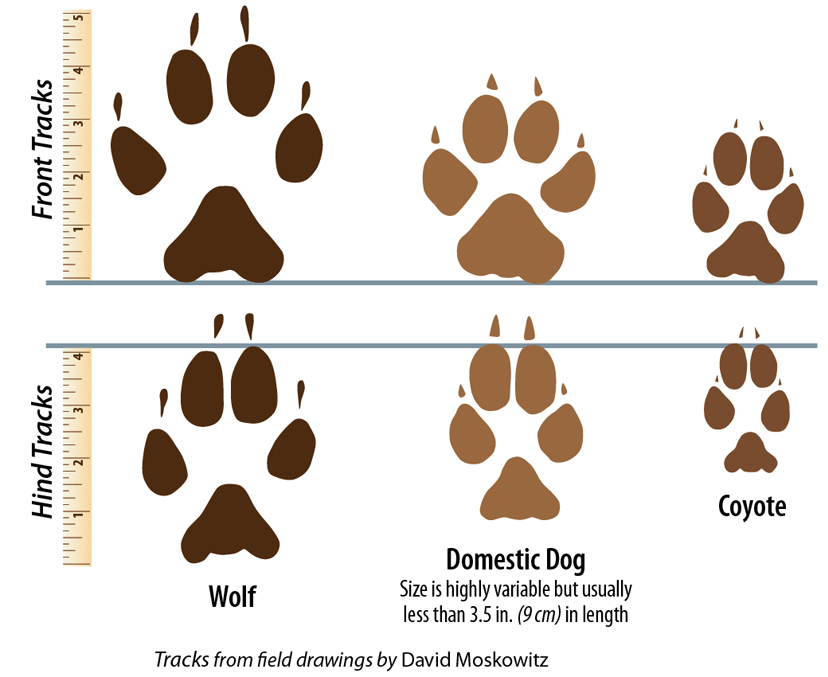
Because wolves are elusive and are rarely seen, finding their tracks can be an exciting experience. The charts and information below illustrate some of the characteristics that distinguish wolf tracks from those of their close relatives, coyotes and domestic dogs. Each species has four symmetrical toes on the front and hind feet, with the front track slightly longer and broader than the hind. Claw marks are usually evident and the front of a wolf’s foot pad is single-lobed. The differences are not always clear so look for a combination of characteristics before coming to a conclusion.
Relative track size differences in wolves, domestic dogs, and coyotes:
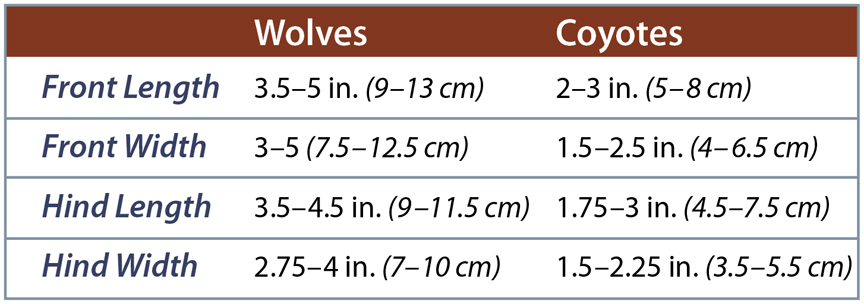
Track size measurements (NOT including claw marks):
Wolves Compared to Coyotes
Adult wolf tracks are larger and more robust than adult coyote tracks. Young wolves’ feet grow large very quickly, and by the time they are about three months old (around July) even young wolves’ tracks are larger than most coyote tracks. Because wolves are much heavier animals than coyotes their tracks will show some spread in their toes, especially on the front track, more often than those of coyotes. In wolves, claws on the front feet are longer than the hind but generally register distinctly in both.
Wolves Compared to Domestic Dogs
Wolf tracks are larger than those of all but the largest breeds of domestic dogs, the genetic descendents of wolves. While many dog tracks can be easily distinguished from wolf tracks, some domestic dogs have tracks that are very similar to wolves, making them indistinguishable in some instances. Use the guidelines below to help in track identification. However, keep in mind that tracks alone cannot distinguish domestic dogs from wild canids with complete certainty.
Toes and Claws
Large dogs often spread their toes with all four toes radiating outward. Spread is less common in wolves and, if it exists, usually only the outer two toes spread. Wolves’ front claws are longer and more strongly apparent in tracks than the hind claws, but can appear distinctly in both. The appearance of claws in dog tracks is variable.
Track Size
The front feet of domestic dogs often have a round appearance with the length and width similar in size. Wolves’ front feet are often more rectangular in overall shape, longer than wide, unless the outer toes have spread. Track size of domestic dogs is highly variable but most dogs leave tracks that are less than 3.5 in. (9 cm) in length, where wolves’ tracks are 3.5 in. (9 cm) and above. Only a few breeds of dogs such as Great Danes, St. Bernard’s and Blood Hounds leave tracks longer than 4 inches. The tracks of German Shepherds, Malamutes, Retrievers and Setters are usually less than 4 inches long.
Wolves Compared to Cougars
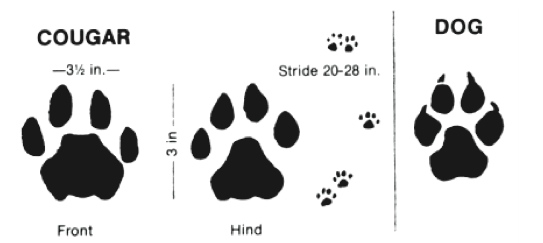
Cougar tracks are often confused with wolf tracks. Distinguishing features of a mountain lion track are its roundness, the shape of the planter pad (main foot pad) and asymmetry of both the foot and the individual toes.
Because cats have retractable claws, mountain lion tracks do not usually show claw marks. This is not always true, however, as cougars sometimes use their claws to increase traction on steep or slippery terrain. Claw marks may also be present if the animal is traveling fast. If claw marks are visible, they will be directly joined to the toe, while the wolf track exhibits a 1/4-inch separation between claw and toe.
Appearance of nearby scats and proximity to people should be considered when large canid tracks are encountered. In some remote areas, large canid tracks may result from the practice of using hounds to hunt mountain lions.
Wolf Scats
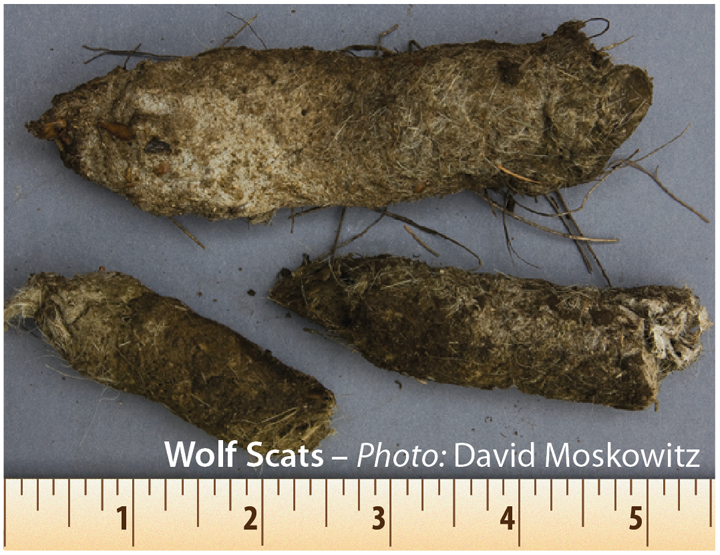
Wolves produce scats, or droppings, which are usually composed of hair, bone fragments, and other signs of their carnivorous diet. Coyote scats, often smaller than wolf scats, typically contain small mammal remains, berries, or insects, but there can be some overlap in contents and appearance. Domestic dog scats are generally more uniform in texture and shape without noticeable hair or bone fragments. Never touch scats to avoid contracting parasites.
Wolf Scats
long and tubular – often strong in smell
range from 1 to 1.5 inches (2.45-4 cm) in diameter
Coyote Scats
twisted and irregular
range from .5 to 1.25 inches (1.5-3 cm) in diameter
Wolves often prey on large animals such as deer and elk. They have very powerful jaws so look for characteristic feeding signs of bone fragments and cracked bones near a carcass. Wolves as well as scavengers will eventually drag off parts of the carcass. Burying an entire carcass is a practice typical of cougars and occasionally bears, but NOT of wolves. If you find a carcass move away from it – bears may take control of a carcass and can be very aggressive.
Please report suspected wolf and wolf track sightings to the Washington Wolf Reporting Hotline at 1-888-584-9038. Washington Department of Fish and Wildlife Poaching Hotline 1-877-933-9847
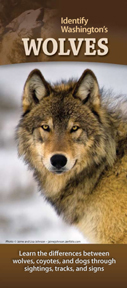
Visit the Products page to see our Identifying Washington’s Wolves brochure.
This page presents an assortment of grizzly bear observation accounts that have occurred in or near to Washington State’s North Cascade Ecosystem. We will keep this page updated as new accounts become available.
How Sightings are Rated – How Reliable are They?
As stated in the report titled the ‘North Cascades Grizzly Bear Ecosystem Evaluation’ [1], North Cascades grizzly bear observations are rated on a reliability scale from Class 1 to Class 4.
Class 1 (confirmed) reliability rating indicated a grizzly bear observation confirmed by a biologist and/or by photograph, carcass, track, hair, dig, or food cache. Grizzly bear sign required verification by a grizzly bear biologist. Tracks were documented by photograph and/or plaster cast and met grizzly bear front foot toe alignment criteria using the Palmisciano Line Method. If tracks were not of sufficient quality to allow the use of the Palmisciano Line Method, they were rated with a lower reliability. Hair samples were guard hairs identified by microscopic examination of basal and shaft scale patters in combination with shaft shield and shaft tip coloration. If structural characteristics of the hair could not be differentiated, the rating was lowered. Digs and food caches required verification by a grizzly bear biologist.
Photo by Jan van der Crabbe
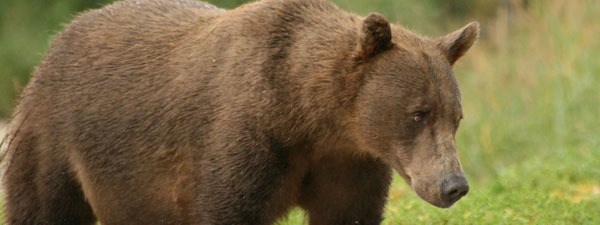
Class 2 (high reliability) report documented and observation of a grizzly bear that was identified by two or more physical characteristics, but lacked verification criteria as noted for a Class 1 observation. The presence of a shoulder hump, long front claws, and concave facial profile were the physical characteristics used to identify Class 2 observations.
Class 3 (low reliability) rating indicated that the observation report included documentation of only one identifying physical characteristic of a grizzly bear, making it impossible to verify the species of bear observed.
Class 4 (not a grizzly bear) rating was given to an observation that was reported as a grizzly bear, but which, upon investigation, was verified to be a species other than a grizzly bear.
Between 1983 and 1991, there were twenty Class 1 sightings, eighty-two Class 2 sightings, and 102 Class 3 sightings.
From 2003 thru 2008, there were 26 reported sightings. Of these, there were one Class 1 sighting, three Class 2 sightings, and one Class 3 sighting.
Photo by Brad Hope
Recent North Cascades Observations
Of North Cascades grizzly bear sightings reported to government agencies between 1950 and 1991, 20 were confirmed and an additional 81 were considered highly probable. Today, the estimated resident population in Washington’s North Cascades is fewer than 20 bears — the estimated population in British Columbia’s North Cascades is also fewer than 20 bears. It is likely the home ranges of a few grizzly bears span the international border.
Upper Cascade River watershed, North Cascades, Washington State, October 2010
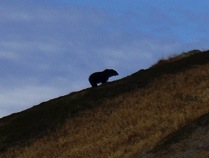
Photos taken by hiker Joe Sebille in October 2010 appeared to be that of a grizzly bear in Washington’s North Cascades. These were initially thought to be the first confirmed grizzly bear photos taken in the North Cascades in possibly a half-century. However, in 2015, additional photos surfaced taken by others in the same region and during the same general time period of the Sebille photos. These photos were less distant with better lighting and detail and appear to be this same bear — a large black bear with the prominent shoulder hump and other features which made it resemble a grizzly bear, especially in the distant profile as can be seen in the photo below. Read the full press release and see the photos.
Image by Joe Sebille via USFWS
Manning Provincial Park, British Columbia, 2010
Just 15 miles north of the border between Washington and Canada this photo (below) of a North Cascades Grizzly Bear was captured in Manning Provincial Park. This is just a mere 2 to 3 hour walk for the bear from Washington State, making it the closest confirmed sighting of a North Cascades Grizzly Bear in years.
Grizzly Bear Image from Remote Camera
Chesaw Grizzly Bear, May 2003
In May, 2003 a rancher witnessed a grizzly bear making its way across his property near Chesaw, Washington. Although this grizzly bear observation was outside the North Cascades Ecosystem, it was only 25 miles east of the North Cascades Grizzly Bear Recovery Zone.
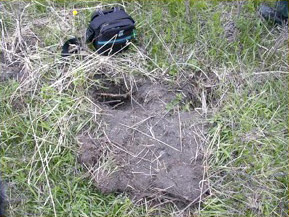
Washington Department of Fish and Wildlife biologists documented by photo, measurement, and plaster cast, several bear tracks found in mud near a spring on the property. They also collected hair samples from a barbed wire fence through which the bear had reportedly passed, as well as bear scat (droppings) found near the tracks and hair. The biologists also found and photographed a small dig site (see below) where a large animal had excavated a ground squirrel burrow, a common foraging behavior for grizzlies, but not typical for black bears
British Columbia Grizzly Bear, 2002
In June 2002, two Canadian hunters came across a grizzly bear in the southern portion of British Columbia. The bear was grazing in a meadow east of Manning Provincial Park (which is directly adjacent to Washington’s North Cascades National Park Service Complex).
Glacier Peak, 1996
In 1996, a bear biologist saw a grizzly bear on the south side of Glacier Peak in the Glacier Peak Wilderness Area.
Thunder Creek, 1991
A photograph of a grizzly bear front track was taken in the Thunder Creek drainage (North Cascades National Park Service Complex) in 1991. This represents a Class 1 level observation, which means that it has been verified as evidence of a North Cascades grizzly bear. To learn more about identifying the difference between grizzly and black bear tracks,click here
Bacon Creek, Whatcom County, 1989
The grizzly bear track photograph below was taken on Bacon Peak (Whatcom County) in 1989. It shows the elongated claw marks on the front track (the lower of the two), and also the “shallow” toe arc that is typical of grizzly bears (and not black bears). To learn more about identifying the difference between grizzly and black bear tracks, click here.
Following section extracted from ‘Grizzly bears’, by David J. Mattson, R. Gerald Wright, Katherine C. Kendall, Clifford J. Martinka, National Biological Service.
Grizzly bears once roamed over most of the western United States, from the high plains to the Pacific coast. As settlers moved west across the Great Plains, their contact with these bears increased.
Grizzly bears are potential competitors for most foods valued by humans, including domesticated livestock and agricultural crops, and under certain conditions can also represent a threat to human safety. For these and other reasons, grizzly bears in the United States were vigorously sought out and killed by European settlers in the 1800’s and early 1900’s.
Between 1850 and 1920 grizzly bears were eliminated from 95% of their original range, with extirpation occurring earliest on the Great Plains and later in remote mountainous areas (Fig. 1a).
Unregulated killing of bears continued in most places through the 1950’s and resulted in a further 52% decline in their range between 1920 and 1970 (Fig. 1b). Grizzly bears survived this last period of slaughter only in remote wilderness areas larger than 26,000 km2 (10,000 mi2).
Altogether, grizzly bears were eliminated from 98% of their original range in the contiguous United States during a 100-year period.
Figure 1a – Approximate distribution of grizzly bears in 1850 compared to 1920.
Figure 1b -Approximate distribution of grizzly bears in 1850 compared to 1970-90.
Protecting Grizzlies from Extinction
Because of the dramatic decline in their numbers and the uncertain status of grizzly bears in areas where they had survived, their populations in the contiguous United States were listed as threatened under the Endangered Species Act in 1975. High levels of grizzly bear mortality in the Yellowstone area during the early 1970’s were also a major impetus for this listing.
Grizzly bears persist as identifiable populations in five areas (Fig. 1b): the Northern Continental Divide, Greater Yellowstone, Cabinet-Yaak, Selkirk, and North Cascade ecosystems. All these populations except Yellowstone’s have some connection with grizzlies in southern Canada, although the current status and future prospects of Canadian bears are subject to debate. The U.S. portions of these five populations exist in designated recovery areas, where they receive full protection of the Endangered Species Act.
Grizzly bears potentially occur in two other areas: the San Juan Mountains of southern Colorado and the Bitterroot ecosystem of Idaho and Montana. There are no plans for augmenting or recovering grizzlies in the San Juan Mountains, but serious consideration has been given to reintroducing grizzlies into the Bitterroots as an “experimental nonessential” population.
Grizzly Bears in the North Cascades of Washington
Hudson Bay Company trapping records show that 3,788 grizzly bear hides were shipped from trading posts in the North Cascades area between 1827 and 1859. The decimation of the North Cascades grizzly bear population continued for more than a century with commercial trapping, habitat loss, and unregulated hunting the leading causes of death. The last grizzly bear to be killed in the North Cascades of Washington was in 1967 in Fisher Creek (in what is now North Cascades National Park).
Of North Cascades grizzly bear sightings reported to government agencies between 1950 and 1991, 20 were confirmed and an additional 81 were considered highly probable. Today, the estimated resident population in Washington’s North Cascades is between 5 and 20 bears (the estimated population in British Columbia’s North Cascades is also 5 to 20 bears). Most likely the home ranges of a small number of grizzly bears span the border.
The Selkirk Mountain Ecosystem includes approximately 2,200 square miles of northeastern Washington, northern Idaho, and southern British Columbia, Canada. There are currently believed to be at between 50 – 70 grizzly bears in the Selkirk Recovery Area with numbers approximately equally divided between the Canadian and U.S. portions of the ecosystem.
You can learn about the history of grizzly bears in the Selkirk Mountain Ecosystem as well as the results of a public opinion survey about bears in the area on our Selkirk Recovery Area page.
Chronology of Events
[slider title=”Click to see the chronology of events”]
Pre-1850s
Grizzly bears are present in all western United States south to the plateau area of Mexico. The grizzly bear population in the lower 48 states is estimated to be between 50,000 and 100,000 individuals.
1827—1859
3,788 grizzly bear hides are shipped from three forts in or near Washington’s North Cascades (3,477 from Fort Colville, 236 from Fort Nez Perce near Walla Walla, and 75 from Thompson’s River in British Columbia), according to records of the Hudson’s Bay Company.
1975
The grizzly bear is listed as a “threatened” species in the lower 48 states under the federal Endangered Species Act.
1981
In Washington state, the grizzly bear is listed as an “endangered” species under state law.
1983 – 1991
153 reports of grizzly bear sightings in the North Cascades. Of these, 21 are confirmed and considered verified Class 1 grizzly bear sightings.
1983
The Interagency Grizzly Bear Committee (IGBC) is established with the goal of recovering grizzly bears in the lower 48 states.
1986 – 1991
The North Cascades Grizzly Bear Ecosystem Evaluation concludes that the North Cascades Ecosystem contains sufficient quality habitat (i.e. food, space, isolation, etc.) to maintain and recover a viable grizzly bear population.
1991
The North Cascades Ecosystem (NCE) is designated a grizzly bear recovery zone by the IGBC. The IGBC identified the zone based on a habitat survey. IGBC recommends that the U.S. Fish and Wildlife Service begin actions to recover grizzly bears in the area. The North Cascades Grizzly Bear Subcommittee is formed about a month later. The NCE recovery zone is nearly 10,000 square miles – 90% of which is public land.
1992
The recovery zone boundaries are developed and recommended by an interagency group working on the North Cascades Grizzly Bear Recovery Chapter.
1992 and 1993
The U.S. Fish and Wildlife Service holds public informational and scoping meetings in Seattle, Mount Vernon, Wenatchee, and Winthrop, WA to identify concerns and familiarize the public with grizzly bear ecology and the recovery process.
1995
Public informational meetings are held to gather comments on the draft North Cascades Grizzly Bear Recovery Chapter.
1996
A survey of 430 Washington residents is conducted by Responsive Management for the Washington Department of Fish and Wildlife to determine the public’s knowledge and attitudes about grizzly bear biology and recovery in the North Cascades. Statewide, 77% of respondents indicate support for recovering grizzly bears in the North Cascades. Respondents living within the recovery zone also largely supported recovery efforts (73% in the western NCE and 64% in the eastern NCE).
1997
The Grizzly Bear Recovery Plan Chapter for the North Cascades Ecosystem is signed by the U.S. Fish and Wildlife Service. The North Cascades Grizzly Bear Committee continues to meet twice a year.
2002
The North Cascades Grizzly Bear Outreach Project (GBOP) begins in Okanogan County (north-eastern NCE).
2003
The North Cascades Grizzly Bear Outreach Project (GBOP) begins in Skagit and Whatcom Counties (north-western NCE).
2003
GBOP conducts attitude and knowledge survey of rural Whatcom and Skagit County residents who live in or near to the recovery ecosystem. The telephone survey contractor reports that 76% of 508 respondents are supportive of recovery (52% strongly supportive).
[/slider]
A Selection of Historical Accounts
Excerpts from Lewis and Clark Among the Grizzlies by Paul Schullery
P 143 and 144
“As Seton and later writers reported, historical evidence of grizzly bears is indeed sparse to nonexistent in the lower Columbia Basin area, though somewhat better the farther you get from the river….In my documentary study of the early historical record (1833 – 1897) of wildlife in the Mt. Rainer area, I was struck by the extreme scarcity of 19th century observations of grizzly bears in that part of the Cascades…Without question, the historical presence of grizzly bears in the Cascade Range north of Mt Rainer has been satisfactorily confirmed… In his study of the early historical record in the area around North Cascades National Park researcher Paul Sullivan quoted early reports from actual sightings…. The most hides traded in any one year at Thompson’s River, BC was 11 in 1851. Apparently 4 hides turned up at Fort Nisqually near present Tacoma … over a period of years…. Sullivan found that much higher numbers of hides came in to the post at Fort Colville, in eastern WA…. The peak year in the GB hide trade there was 1849 when 383 hides came through…. Fort Nez Pierce, near present Walla Walla had its peak year in the GB hide trade in 1846 when 32 hides came through…”
[slider title=”Click to read more historical accounts”]
Following excerpts from Range of Glaciers
by Fred Beckey (2003)
“On June 19 (1859)….the men made camp below the lake’s outlet under a group of firs. That evening, the hunter-guide killed a small grizzly bear amid ‘steep and almost perpendicular cliffs opposite’ the camp. The bear tumbled over brush and rock, Custer reported: ‘The Indians brought it to camp in Triumph, 4 men carried it on 2 poles. This was of course the signal of another enormous feast…. it continued vigorously through the whole night, until the last vestige of the carcass had disappeared.’ Custer found the bear’s meat coarse and not very palatable, ‘except the tongue, which is really an excellent morsel.'” P181 and 182.Custer’s Nooksack.
“Herders generally lost a horse per year and always lost sheep or their way to the high country. The animals either wandered off or were killed by bears or coyotes, and most herders killed every bear they saw, including grizzlies.” P 405. In a paragraph referring to sheep bands in the Lake Chelan, Entiat, Teanaway and Napeequa River areas 1895-1950.
Following excerpts from Valley of the Spirits: The Upper Skagit Indians of Western Washington
by June McCormick Collins (1974)
P 52
“The Upper Skagit hunted deer, elk, mountain goat, black bear (may be brown or cinnamon), grizzly bear, beaver, snowshoe rabbit, fisher, raccoon, and land otter.”
P 147 and 148
Bear was a spirit which gave hunting power. One informant’s father had had this spirit. In dancing during the winter ceremonial, he would dance right into the fire and not be injured because of this spirit…. There is some implication that men who have this spirit tend to have large feet and deep voices as bear-like characteristics….I have already mentioned in passing the special attention given to the bear by the Upper Skagit. In a myth the bear and the ant have a contest to see how long the alternating periods of daylight and night would be.”… (entertaining)… ” The ant won the contest despite his smaller size. The bear then went into a cave for three months each winter….This same myth is also told with rabbit in the character of the ant and with grizzly bear or beaver in the character of bear.”