This past Saturday a resident form Sammamish notified me of three bears hanging out in her neighbor’s tree. I quickly turned my car around and headed to her house. When I arrived, there were five people in the street, heads up, staring at a 70 foot cedar tree. I knew the bears had to be in that tree, but they were barely visible. Soon my eyes picked out the three black spots hidden in the branches. The resident who called me explained that the bears broke into her neighbor’s chicken coop and ate a few chicks. Fish and Wildlife was called to set a trap next to the chicken coop.
I found out the neighbor has lived in this Sammamish neighborhood for seven years and never saw bears until last year when construction began nearby on a new subdivision. She believes this same sow was spotted last summer rummaging through garbage and feeding on bird feeders. Following these incidents, the entire neighborhood worked together to remove attractants and keep garbage stored inside until the morning of garbage pick-up. Unfortunately, the allure of the chickens was too great for the sow to resist. I gave the neighbor information about electric fencing the coop and also reminded her to remove ripe or fallen fruit from her apple trees.
For more tips on coexisting with bears visit GBOP’s website.
I have lived in the bear country of Issaquah Highlands since 2004. A community of 2,600 homes, Issaquah Highlands is located in the foothills of the Cascade Mountains where black bear, cougar, bobcat and deer wander. For these reasons, it’s also a fascinating case study in an area where wildlife and people share habitat.
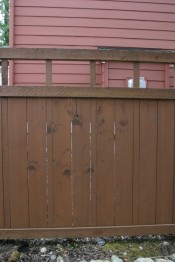
Black bear paw prints on fence
In 2007, I became aware of the black bears because of several bear sightings. On one sunny afternoon, my husband and I saw a bear wondering leisurely through our neighborhood park while riding our bikes. Another time we saw a bear behind our house in the greenbelt and then a bear jumped over our fence in the early morning to eat the grapes rotting in our yard waste bins. We quickly realized that simply storing our garbage, recycle and yard waste bin in the garage until the morning of garbage pick-up immediately solved the problem. The bears stopped coming.
These incidents motivated me to talk to my neighbors about ways to prevent attracting bears into our backyards. On a weekly basis, I took it upon myself to monitor bear activity in my community by taking photos of strewn garbage and mapping neighborhoods that had reported bear incursions. I also initiated a dialogue with the Issaquah Highlands Homeowners Association and the Board of Directors about the problems along with my closest ally and neighbor TK Panni. It was around this time that Chris Morgan of GBOP contacted me and offered help and resources.
Through GBOP I’ve been able to intensify my activities in the Issaquah Highlands and also expand my reach to include those who want to learn about grizzly bears as well. My area of focus for GBOP stretches from my backyard across I-90. What’s good for black bears is good for grizzly bears, is good for people.
After attending many board meetings, monitoring black bear/garbage incursions for countless hours, gathering community support for regulatory change and lots of perseverance, our efforts finally paid off. At the December 2010 Board meeting, the Issaquah Highlands Board adopted the following rule and regulation change regarding the storage of garbage, recycling and yard waste bins:
Any trash (grey), recycling (blue), or yard waste (green) containers and/or bags must be stored indoors during non-pickup hours.
Trash cans may only be placed at the curb/street for pickup 12 hours prior to and 12 hours after pickup time.
The ARC will consider variance requests in accordance with the variance policy in section 4.5 of the CCR’s under the following circumstances:
Topography
Natural Obstructions
Hardship
Garbage tipped over by bear
In addition to the rule change, we urged the Board to adopt the Bear Smart Best Practices which they did. It provides many tips for people trying to prevent bears from accessing non-natural attractants in residential neighborhoods. Some of the recommendations include advice about not feeding birds when bears are active (you may be surprised that black sunflower seeds draw bears into yards from miles away), cleaning and storing barbecues after each use and only placing garbage or food smelling cans outside on the morning of garbage pick-up. Residents can access the best practices via the Rules and Regulations of Issaquah Highlands, on the Issaquah Highlands website or in our local newspaper.
By becoming Bear Smart, we can all learn to live safely with black and grizzly bears, encouraging bears to forage in the wild, away from human homes. One of GBOP’s goals is to reduce human-bear conflicts. The passage of this rule in the Issaquah Highlands is an important step in that direction. It’s also a great example of a community that cares enough to make a small change so that bears and people can thrive.
For tips on co-existing with bears, see the GBOP page
It was two and a half years ago that the gray wolf returned to the rolling hills of Washington’s Methow Valley, after a 70-year absence. Today it’s unclear if the Methow Lookout Pack still exists.
There has been one loss after another. The carcass of a dead gray wolf was found dumped near the highway. A FedEx worker uncovered the pelt of a wolf in a bloody, leaking box that an Okanogan County resident tried to ship to Canada. And since last summer, the alpha female suspiciously disappeared which caused the social structure of the pack to deteriorate.
A couple of sightings suggest there are two to three wolves left traveling together. There is hope that a Lookout wolf will find a new mate this spring. Read the entire Seattle Times article
While on a short trip to Idaho I came across this great article on grazing and endangered species and so I’ve written a brief synopsis of the article for those that may be interested.
In the Northern Rockies region the National Wildlife Federation (NWF) has been compensating ranchers who give up their grazing rights on federal lands. “It’s a win-win for the ranchers and for the Grizzly Bears and Wolves and other wildlife” says one U.S. official.
Some ranchers have stopped using part of their grazing allotments and an innovative NWF program compensates the rancher for giving up the grazing rights which the public agency in charge then permanently retires. One rancher, who had an allotment on the Gallatin National Forest, recently took home a check for $50,000; the bison, grizzlies, and wolves got the land and both parties left the table satisfied with the end result. To date this program has taken cattle and sheep off more than 600,000 acres of prime wildlife habitat in Montana, Idaho, and Wyoming.
The program has won cautious acceptance from livestock groups. Errol Rice, executive vice president of the Montana Stock-Growers Association says that “If a rancher feels it is in his best interests to participate, we support that decision”.
The NWF program is not new and models a similar plan started by bighorn sheep hunters in the 1980’s. When bighorn numbers had dropped from 2 million to around 15,000 the Foundation for North American Wild Sheep began to buy up and retire grazing permits in bighorn habitat areas; they were the pioneers.
There are many benefits to this program: financial compensation to the ranchers, separates sheep and cattle from wolves and grizzlies diffuses controversy, and reduces the need to kill or remove animals preying on cattle and sheep. The innovative program has even reached out to private landowners and brokered a deal on National Wildlife Refuge land. There is still work to be done and new twists and angles to be explored but the success of the program is evident in its accomplishments.
Find out more about this NWF program and read the full story
As sheep graze in an Arizona pasture a wire fence keeps them from wandering into the road. All along the length of the electrified fence long slips of magenta plastic (termed fladry) flutter in the wind. Wolves tend to stay clear of the decorated electrified fences, and for the past three years, it has worked for Carey Dobson. He has not lost any sheep to wolf depredation.
A few miles away, a rancher hired a range rider, a cowboy or cowgirl who monitors the cattle herd, to make sure the herd stays safe. It has been two years, and so far it seems to be working. Read more in this New York Times article