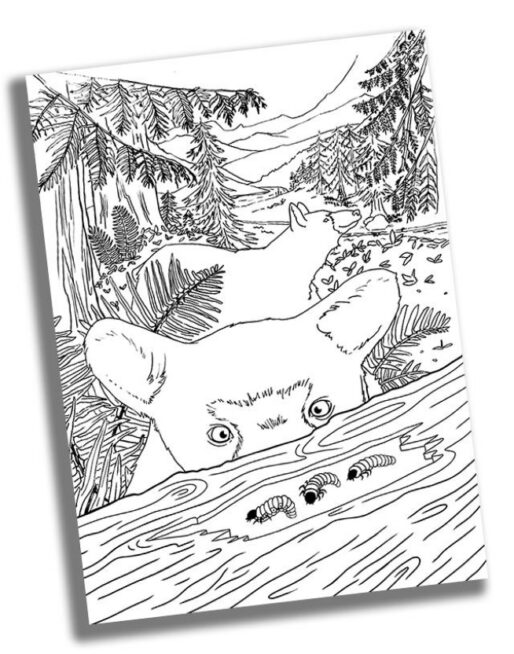
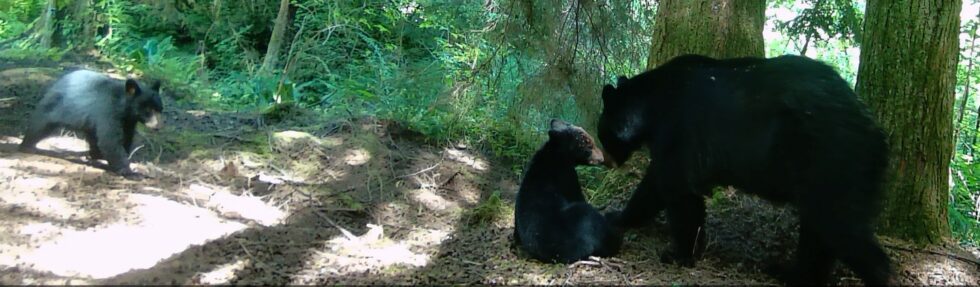
We’re excited to share a first look at our upcoming Wildlife Activity Book with a special early release designed for young learners and wildlife enthusiasts alike. Bear Cub Meets Grubs is a coloring page set inspired by real-life moments captured by trail cameras of a North American black bear and her cubs foraging and playing in a forest near Woodinville, WA.
The first page shows a black bear cub discovering springtime grubs walking across a log. The second page shows the larger scene with Mama Bear in the background scenting the forest air. The scene invites kids to explore the hidden stories of wildlife living in their own backyard. The scientifically accurate illustration is a simple, meaningful way to introduce young people to:
Animal behavior (foraging) and seasonal change (spring)
Observation (look at those ears!) and storytelling (what do bears eat?)
Creative, nature-based learning
🐻 Support the Project
Every dollar purchase helps bring the full Wildlife Activity Book to life—and that matters because early, accessible education shapes how the next generation understands and coexists with wildlife. By supporting this project, you’re helping create tools that teach kids not just what animals are, but how they behave, why they matter, and how we can live alongside them responsibly. At a time when large carnivores are often misunderstood, building curiosity, empathy, and science-based awareness in young learners is one of the most powerful ways to support long-term conservation and healthier ecosystems.
The Speak For Wolves Conference is moving to Washington state.
Speak for Wolves Returns to Washington—Stronger Than Ever
The Speak for Wolves Conference, now a program of Western Wildlife Outreach, is returning April 2027 for an in-person conference in Washington state.
📍 Olympia, Washington 📅 April 2027
As a nationally recognized gathering, Speak for Wolves brings together educators, scientists, indigenous leaders, policymakers, and advocates working at the forefront of large carnivore conservation. This annual conference is more than an event—it’s a catalyst for action, advancing science-based solutions and policy reform for wolves and other keystone species across the Pacific Northwest. From accessible advocacy resources to timely action alerts, Speak for Wolves empowers individuals to engage directly in shaping the future of wildlife conservation.
by Hallie Sykes, Farmer Frog Garden Educator, Woodland Park Zoo Advanced Inquiry Masters Degree Program
On a chilly, yet sunny, spring afternoon this April a dozen community members gathered to learn how to share the landscape with black and grizzly bears in a workshop hosted by Western Wildlife Outreach. The workshop featured Zoe Hanley, Senior NW Representative at Defenders of Wildlife, whose work involves promoting non-lethal deterrents as a tool to prevent gray wolf depredation on livestock. Defenders is also involved with supporting grizzly bear coexistence in the North Cascades and Selkirk ranges of Washington state.
The workshop was held at Farmer Frog in the Paradise Valley Conservation Area which is 700-acres of undeveloped land set aside to protect the headwaters of Bear Creek, one of the most productive wild salmon streams left in Western Washington. This landscape provides a refuge for bears, cougars, coyote, bobcat, deer and other wildlife.
Western Wildlife Outreach planned the training to educate people about bear biology, black and grizzly bear identification, how to handle bear encounters, and securing bear attractants around the home and campsite.
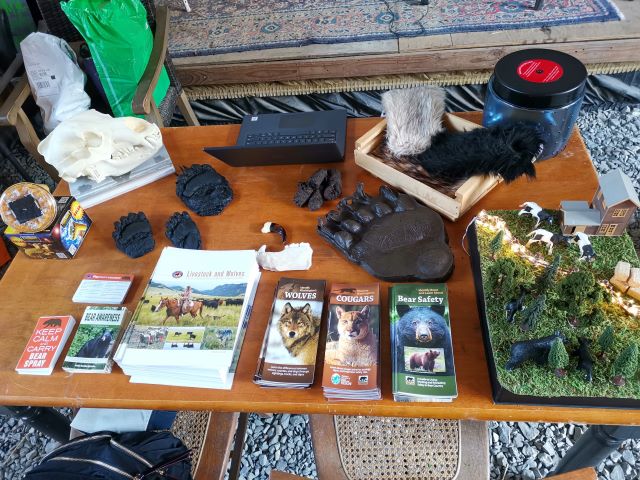
Bear Safety & Coexistence Workshop props: bear safety education materials, a bear-proof storage can, bear tracks, skull and scat example, a farm diorama. Photo credit: Hallie Sykes
Participants gathered eagerly and several shared their bear stories.
“I have bears every year,” said Jeanne Weiss, a resident of the area surrounding Paradise Valley. Jeanne knows that we are living alongside wild animals because she documents them. “We have cameras and we’ve seen bears, coyotes, bobcats, deer, cougars.”
She came to the workshop hoping to learn strategies to deal with bears visiting her unfenced backyard where her dogs some times run into them. Hanley mentioned that half of bear encounters in WA state are caused by off leash dogs because the bear ends up chasing the dog back to the human. Hanley reassured Jeanne that bear spray and the workshop training would be a key tool for handling such an encounter in the future.
Adel Krupp, who attended the workshop with her two teenagers, also wanted to learn how to coexist with wildlife at home. The only participant this day with livestock (chickens) she got some key advice from Hanley about using a three strand electric fence to surround the coop, including the top of it, as a deterrent to bears and other wildlife.
Krupp will also follow Hanley’s advice to take down the bird feeders from April to November when bears go into denning season. Winter is actually the only time when song birds are in need of food supplementation to help get through the winter months participants learned.
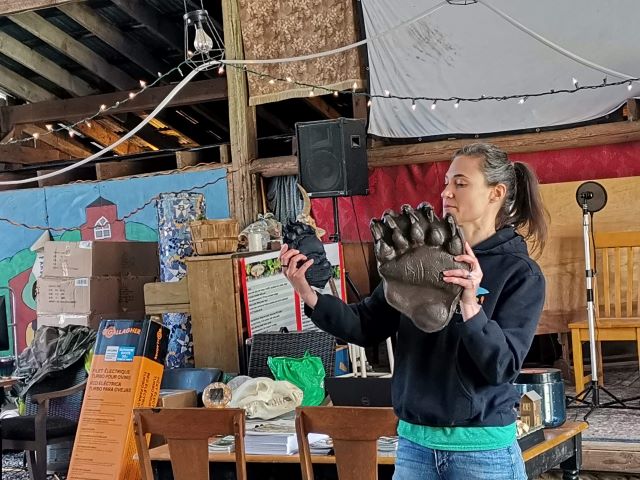
Zoe Hanley compares the track patterns of a Kodiak grizzly bear to a black bear. The grizzly track she is holding is much larger than grizzlies in Washington, which is home to less than a dozen in the easter side of the state. An encounter with one of Washington’s 20,000 black bears is much more likely. Photo credit: Hallie Sykes
Bear encounters are more likely to occur during the months of March through November when bears are working to consume calories to make it through their denning/hibernation season. An encounter with a bear has significant risks for people and pets and also bears themselves. If they become a nuisance the bear must be trapped, relocated or even killed if they’ve become habituated to human provided food sources.
“It’s a privilege to see them but we don’t want to be drawing wild animals in close to our homes. When they get acclimated to human foods that’s when bears get killed,” said Hanley.
While workshop participants generally didn’t have a lot of concerns themselves about bears, several expressed they felt people in their community were more afraid of bears than they needed to be. Bear attacks are extremely rare. Only 2-5 people die per year in all of North America.
Hanley stated the best thing to do is try not to surprise the bear. A surprised bear may display behaviors such as huffing, teeth clacking, rocking on legs, and even a fake-out “bluff charge” where they sprint and then stop short. Other behaviors you might witness during a bear encounter include more of a curious stance on their hind legs (used when a bear wants to get a better look at something).
If either a black or grizzly bear gets too close to you – stand your ground!
Have bear spray ready, don’t turn your back or run, back up slowly. If the bear keeps approaching deploy the bear spray by aiming it at the ground about eight feet in front of you. Spray to create a wall of the deterrent in front of you in order to stop the bear’s forward movement. In the rare case that doesn’t work and the bear attacks, fight back.
Other tips to avoid these situations are: make noise on the trail, keep children close in sight, hike with dogs on leash, don’t approach dead animals, carry bear spray, keep it at hand and know how to use it. At your campsite don’t store food or smelly things like deodorant in your tent. Pack it in, pack it out.
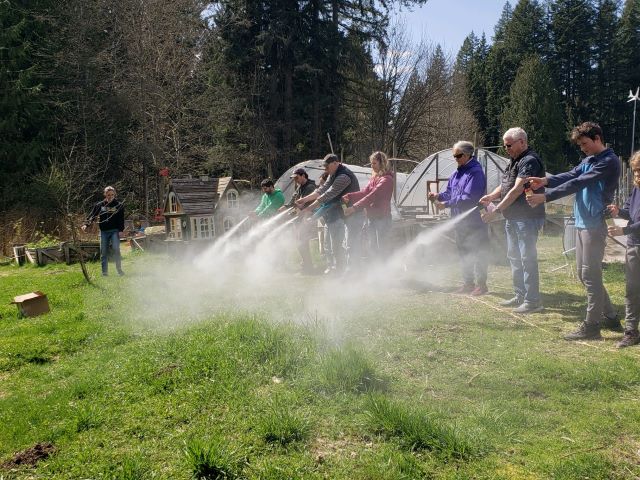
After learning about minimizing attractants, learning about bear behavior and safety tips for dealing with them, participants went out behind the barn to practice using bear spray. Hanley recommends carrying two bear spray canisters when backpacking because the spray can be exhausted after three bursts of 2-3 second sprays.
Workshop participants line up and deploy practice cans of bear spray, aiming at the ground in front of them to create a wall of spice, versus aiming directly at a bear. Photo credit: Lynn Okita
Workshop attendees appreciated the opportunity to learn a new skill and got to take home a free can of bear spray donated by Counter Assault. They also appreciated learning what to do if bear spray gets in their own eyes as well.
Water, Air, and Time were the three first aid words to remember.
Rinse with water and don’t rub your eyes since the grains of capsaicin can aggravate the eye if rubbed. Allow your eyes to use tears to move the spray out. Keep them open and exposed to the air. In time the discomfort will pass, only lasting for 30 minutes or so.
All of this is a better alternative than a bear attack, which Hanley again mentioned is very rare. Even with her vast experiences in the wilderness she has never had to use bear spray. However, it does provide peace of mind.
To learn more about Bear Identification and Bear Safety, visit these links here on the Western Wildlife Outreach website and join this group of newly empowered community members in promoting awareness and peaceful coexistence with our wild animal neighbors.
Being at the top of the food chain means that apex predators such as bears, wolves and cougars can be easily toppled when the biological foundations of their ecosystems collapse. Maintaining healthy habitats for these keystone species protects countless other species that share the landscape with them.
While the full long-term impacts of climate change on different ecosystems are difficult to predict, there are a number of likely scenarios that we can be aware of and manage for today:
Rainfall and the availability of water will shift. Rising temperatures will result in smaller snowpacks and earlier snowmelt. This will result in shortages of mid- to late-summer water supplies and shifts in the availability of carrion.
Vegetation patterns are already shifting, resulting in migration of prey to new areas and the local elimination of various plants that carnivores and their prey rely on for food.
Warmer temperatures will allow diseases to spread into new areas where the resident wildlife has not had the opportunity to develop resistance. This is already occurring with blister rust and other vegetative diseases attacking many northern tree species, and a spread of dangerous nematodes among muskoxen in northern Canada.
The speed of temperature changes will stress many species before they are able to adapt to the new conditions. This will weaken species that are not able to move to newly created, more suitable habitat and will reduce biodiversity, thus reducing resilience in many ecosystems.
What is Landscape Connectivity?
The more diverse an ecosystem, the better equipped it is to deal with environmental changes in the environment. Reducing human impacts such as roads and other developments in wilderness areas keeps habitat from getting fragmented into unusable parcels, slows the incursion of invasive species, and more. Scientists have found that large carnivores do better when they have expansive ranges for finding food and are able to move freely between landscapes to follow prey and other food sources.
For large carnivores to overcome climate-related challenges, they need big, connected tracts of suitable habitat. This will become even more critical as climate change progresses and the alterations in landscapes become more extreme. In fact, according to the Washington Wildlife Habitat Connectivity Working Group, “maintaining connectivity is the single most frequently recommended strategy to reduce the threat of climate change to biodiversity.”
Animals, particularly large ones, need two types of movement. As individuals, they need to be able to move freely within their home range in order to meet the needs for their daily survival – finding food, shelter and a mate. As a species, they also need movement outside of that home range and into other suitable habitat to share genes with other populations to avoid inbreeding and for young males to disperse and create new home ranges.
Human impacts have already made both types of movement more difficult for large carnivores such as bears, cougars, and wolves. Roads, housing developments and forest clear-cuts have fragmented once-intact habitat for wildlife. These incursions into wild lands have also increased human-wildlife conflict, causing an increase in lethal control measures used on predators.
Even if an animal’s core habitat is still intact and allows movement within a home range, human development surrounding the habitat can create an “island effect.” This means that the animal or its offspring can’t reach another area to establish new territory or share genes with another population, or travel to find food if climate change makes its current range uninhabitable. Therefore, it is critical that we preserve corridors between wild landscapes that will allow large predators to seek out suitable habitat if their old ranges stop meeting their needs.
Large Carnivores Mitigate Climate Change
The snowpack in mountainous areas is already melting earlier every year as a result of climate change. This, combined with warmer air temperatures, allows plants to begin sprouting earlier in the spring. While this is great news for the elk and deer that feed on those plants, it is not so great for the scavengers.
Longer winters are more stressful for wildlife, and as the winter lingers on, more animals succumb to starvation. This means that in late winter and early spring, there is an abundance of carcasses for the scavengers to feed on. Earlier sprouting and earlier exposure of plants provides food to browsers and grazers before they reach this critical point.
In the absence of predators, earlier melt will cause fewer carcasses to be available, and scavengers such as bald eagles, ravens and coyotes that rely on that source of meat to make it through the last bit of winter will go hungry. Wolves and cougars continue to provide those carcasses through their hunting, and provide a bridge to late spring and summer when more food is available.
Climate change is forcing a whole new approach to wildlife management. Whereas past practice was to try to maintain or restore some historical baseline, that approach is no longer relevant. An area that has provided ideal habitat for wolves or grizzly bears for thousands of years may never be able to support them again, and landscapes that have never held these species may suddenly become critical habitat for them.
Even our national park boundaries may soon be irrelevant in terms of maintaining the mix of species they are currently protecting. What this means is that we need to look beyond single management units. We need to maintain many healthy, functioning ecosystems, and provide good connectivity between them to allow flora and fauna to redistribute to suitable locations.
The future of wildlife management is going to require nimble strategies that can adapt to unforeseen changes. It will be necessary to regularly monitor wildlife populations, track the movements of prey species and the vegetation they feed on, and adjust management regimes to new realities. By using a flexible approach to the management of large carnivores and their habitats, we can lay the foundation for sustainable populations of these species to thrive through a changing climate.
This week Western Wildlife Outreach staff accompanied Washington Department of Fish and Wildlife Enforcement Officers and the Karelian Bear Dog Team into the field to release four black bear cubs. A shout out to the folks at PAWS in Lynnwood, WA who do such great work with black bear rehabilitation and making this day possible. And a huge WWOOF! to WDFW’s KBD Team, human and canine!