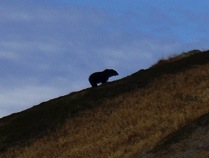
 U.S Fish and Wildlife Service Press Release this week announced a verified grizzly bear sighting in the North Cascade Mountains of Washington – the first since 1996. The fact that my home state remains wild enough to accommodate a grizzly bear gives me a sense of pride. Few ecosystems in the lower 48 states remain ecologically robust enough to support healthy grizzly bear populations. Many of us chose to live in states such as Washington, Idaho, Montana and Wyoming because of the vast amount of wilderness that they still offer. And with all those wild spaces come a few wild animals. The US Fish and Wildlife Service, charged with recovering and conserving the threatened grizzly bear, believes there are fewer than 20 grizzly bears living in the North Cascades.
Though the North Cascades could technically support more than 20 grizzlies, fewer exist due in part to human-caused mortality. In order for grizzly bears numbers to increase, be delisted from the federal Endangered Species List, then be managed by the state wildlife agencies, attention must be paid to decreasing conflict between humans and grizzlies. Human-caused mortality of grizzly bears can be attributed to a number of circumstances, including mistaken identity (with black bear), poaching, and sanitation issues. Bird feeders, unsecured garbage, pet food and other household articles are strong attractants for bears. These home-fed bears often become habituated and are removed by state agencies to resolve or prevent conflict with home owners and their wild neighbors.
GBOP Field Representatives meet with community members in Washington and northern Idaho to discuss ways to help keep humans safe and bears, like the recently spotted grizzly, wild. Read more about grizzly bear biology and behavior, legal status and recovery, safety, and tips for coexistence on our website. GBOP looks forward to speaking with and listening to local stakeholders about the recent grizzly sighting, locals’ experiences with and opinions about bears, and the ways in which humans and bears can safely inhabit a shared landscape. –Like the large, wide, and wild North Cascades.