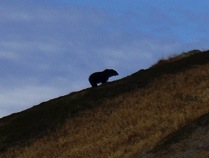
Chris Morgan blogs about bear safety

Chris Morgan, Co-Director of the Grizzly Bear Outreach Project, wrote a recent blog on PBS’ website about the bear attack in Yellowstone and what you can do to be safe.

A must read for anyone who is working, recreating, or living in bear country.

One of the key elements of staying safe in bear country is prevention. Bears don’t like to be surprised – especially grizzly bears that may be defending cubs or a prized food cache. It goes without saying that hiking in groups increases safety – making noise reduces the likelihood of an unwanted confrontation with a defensive bear. Smaller groups have to be very conscious of making noise – especially when the wind is in your face (the bear ahead can’t smell you), or when in thick brush, approaching blind bends in the trail, or hill rises, or when hiking alongside a noisy creek. I’m often the loudest guy on the trail – belting out a “Hey bear!” every so often politely warns a bear of your approach and enables them to take diversionary action

Click here to read the entire blog

Fourth Washington Wolf Pack Confirmed

Washington Department of Fish and Wildlife confirmed last week that a new pack of gray wolves are living near Teanaway River north of Cle Elum, about 90 miles east of Seattle.  The Teanaway Pack is the first pack to return to Kittitas County since wolves were exterminated over 50 years ago.

DNA tests confirmed that a trapped wolf near the Teanaway River is a lactating female, indicating she recently gave birth. Additional DNA test will help explain where the wolves came from (British Columbia or the Rocky Mountains), but the number of wolves in the Teanaway pack is still unknown.

Regardless of where the Washington wolves originated, they re-established themselves; they were not reintroduced by federal agencies as they were in Idaho, Montana and Wyoming.  It will be interesting to see if this fact makes a difference in local perceptions of wolves and their management in Washington, relative to other western states.

The Teanaway confirmation has occurred as Washington State finalizes its wolf management plan.  Currently, wolves in the western 1/3 of the state remain on the Federal Endangered Species List, while the western 2/3 remain on the State Endangered Species List.

See a map of current Washington wolf pack locations.

Male Bears Responsible for Majority of Fatal Black Bear Attacks

While female grizzly bears with young have always been considered to be the more dangerous sex, a recent study by bear biologist Stephen Herrero suggests that the opposite may be true for black bears. Herrero’s study on fatal black bear attacks from 1900 to 2009, published in the Journal of Wildlife Management, shows that male black bear are responsible for over 90% of the 63 fatal attacks on humans in the U.S. and Canada.

While the number of attacks per decade has risen since the 1960s, it is not thought to be due to bears becoming more aggressive, but due to more people living and recreating in bear habitat. The study also suggests a correlation between the attacks, food availability and a bear’s lack of previous experience with humans.

Listen to a recent interview with Dr. Herrero and learn more about his study, the two different types of bear attacks; Defensive and Predatory, and what steps to take if faced with either type of attack. Also visit GBOP’s Tips for Coexistence and Bear Safety pages.

North Cascades Grizzly Bear Sighting

U.S Fish and Wildlife Service Press Release this week announced a verified grizzly bear sighting in the North Cascade Mountains of Washington – the first since 1996. The fact that my home state remains wild enough to accommodate a grizzly bear gives me a sense of  pride. Few ecosystems in the lower 48 states remain ecologically robust enough to support healthy grizzly bear populations. Many of us chose to live in states such as Washington, Idaho, Montana and Wyoming because of the vast amount of wilderness that they still offer. And with all those wild spaces come a few wild animals. The US Fish and Wildlife Service, charged with recovering and conserving the threatened grizzly bear, believes there are fewer than 20 grizzly bears living in the North Cascades.

Though the North Cascades could technically support more than 20 grizzlies, fewer exist due in part to human-caused mortality. In order for grizzly bears numbers to increase, be delisted from the federal Endangered Species List, then be managed by the state wildlife agencies, attention must be paid to decreasing conflict between humans and grizzlies. Human-caused mortality of grizzly bears can be attributed to a number of circumstances, including mistaken identity (with black bear), poaching, and sanitation issues. Bird feeders, unsecured garbage, pet food and other household articles are strong attractants for bears. These home-fed bears often become habituated and are removed by state agencies to resolve or prevent conflict with home owners and their wild neighbors.

GBOP Field Representatives meet with community members in Washington and northern Idaho to discuss ways to help keep humans safe and bears, like the recently spotted grizzly, wild. Read more about grizzly bear biology and behavior, legal status and recovery, safety, and tips for coexistence on our website. GBOP looks forward to speaking with and listening to local stakeholders about the recent grizzly sighting, locals’ experiences with and opinions about bears, and the ways in which humans and bears can safely inhabit a shared landscape. –Like the large, wide, and wild North Cascades.

Bear resistant trash cans could help in Issaquah

Following up on recent bear incidents in Issaquah, the Seattle news station King 5 aired a story on June 14, 2011 investigating if Waste Management was planning to take any action. Waste Management was up to the challenge.

For the past several months, as a GBOP field representative, I have been collaborating with Waste Management and the City of Issaquah in researching bear resistant cans. During the initial 6 month trial, different designs of bear resistant cans will be tested with refuse trucks throughout various neighborhoods. The design that is most durable, keeps the bears out, is child safe and user-friendly for residents and Waste Management will be selected and offered to residents of Issaquah. This will greatly reduce the potential for human bear conflict and minimize bears frequenting our neighborhoods rummaging through garbage.