Outdoor Recreation Enthusiasts Learn Bear Safety

by Hallie Sykes, Farmer Frog Garden Educator, Woodland Park Zoo Advanced Inquiry Masters Degree Program

On a chilly, yet sunny, spring afternoon this April a dozen community members gathered to learn how to share the landscape with black and grizzly bears in a workshop hosted by Western Wildlife Outreach. The workshop featured Zoe Hanley, Senior NW Representative at Defenders of Wildlife, whose work involves promoting non-lethal deterrents as a tool to prevent gray wolf depredation on livestock. Defenders is also involved with supporting grizzly bear coexistence in the North Cascades and Selkirk ranges of Washington state.

The workshop was held at Farmer Frog in the Paradise Valley Conservation Area which is 700-acres of undeveloped land set aside to protect the headwaters of Bear Creek, one of the most productive wild salmon streams left in Western Washington. This landscape provides a refuge for bears, cougars, coyote, bobcat, deer and other wildlife.

Western Wildlife Outreach planned the training to educate people about bear biology, black and grizzly bear identification, how to handle bear encounters, and securing bear attractants around the home and campsite.

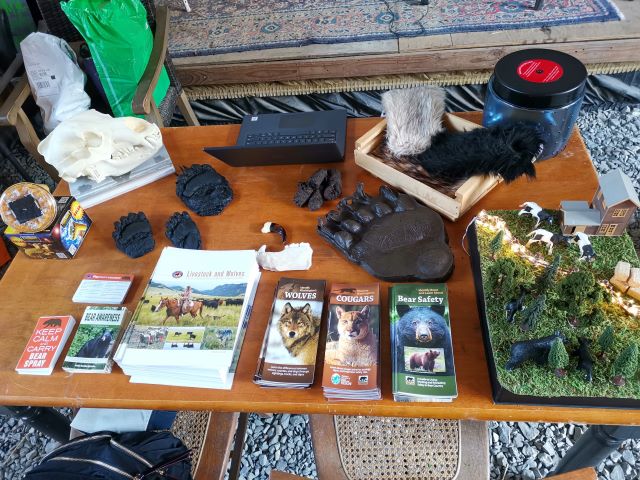
Bear Safety & Coexistence Workshop props: bear safety education materials, a bear-proof storage can, bear tracks, skull and scat example, a farm diorama. Photo credit: Hallie Sykes

Participants gathered eagerly and several shared their bear stories.

“I have bears every year,” said Jeanne Weiss, a resident of the area surrounding Paradise Valley. Jeanne knows that we are living alongside wild animals because she documents them. “We have cameras and we’ve seen bears, coyotes, bobcats, deer, cougars.”

She came to the workshop hoping to learn strategies to deal with bears visiting her unfenced backyard where her dogs some times run into them. Hanley mentioned that half of bear encounters in WA state are caused by off leash dogs because the bear ends up chasing the dog back to the human. Hanley reassured Jeanne that bear spray and the workshop training would be a key tool for handling such an encounter in the future.

Adel Krupp, who attended the workshop with her two teenagers, also wanted to learn how to coexist with wildlife at home. The only participant this day with livestock (chickens) she got some key advice from Hanley about using a three strand electric fence to surround the coop, including the top of it, as a deterrent to bears and other wildlife.

Krupp will also follow Hanley’s advice to take down the bird feeders from April to November when bears go into denning season. Winter is actually the only time when song birds are in need of food supplementation to help get through the winter months participants learned.

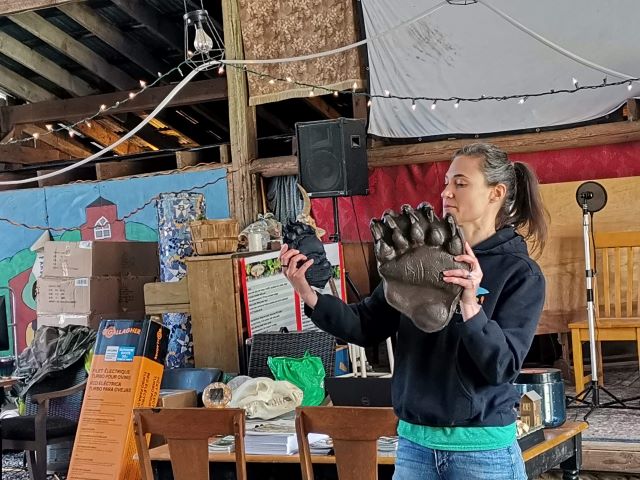
Zoe Hanley compares the track patterns of a Kodiak grizzly bear to a black bear. The grizzly track she is holding is much larger than grizzlies in Washington, which is home to less than a dozen in the easter side of the state. An encounter with one of Washington’s 20,000 black bears is much more likely. Photo credit: Hallie Sykes

Bear encounters are more likely to occur during the months of March through November when bears are working to consume calories to make it through their denning/hibernation season. An encounter with a bear has significant risks for people and pets and also bears themselves. If they become a nuisance the bear must be trapped, relocated or even killed if they’ve become habituated to human provided food sources.

“It’s a privilege to see them but we don’t want to be drawing wild animals in close to our homes. When they get acclimated to human foods that’s when bears get killed,” said Hanley.

While workshop participants generally didn’t have a lot of concerns themselves about bears, several expressed they felt people in their community were more afraid of bears than they needed to be. Bear attacks are extremely rare. Only 2-5 people die per year in all of North America.

Hanley stated the best thing to do is try not to surprise the bear. A surprised bear may display behaviors such as huffing, teeth clacking, rocking on legs, and even a fake-out “bluff charge” where they sprint and then stop short. Other behaviors you might witness during a bear encounter include more of a curious stance on their hind legs (used when a bear wants to get a better look at something).

If either a black or grizzly bear gets too close to you – stand your ground!

Have bear spray ready, don’t turn your back or run, back up slowly. If the bear keeps approaching deploy the bear spray by aiming it at the ground about eight feet in front of you. Spray to create a wall of the deterrent in front of you in order to stop the bear’s forward movement. In the rare case that doesn’t work and the bear attacks, fight back.

Other tips to avoid these situations are: make noise on the trail, keep children close in sight, hike with dogs on leash, don’t approach dead animals, carry bear spray, keep it at hand and know how to use it. At your campsite don’t store food or smelly things like deodorant in your tent. Pack it in, pack it out.

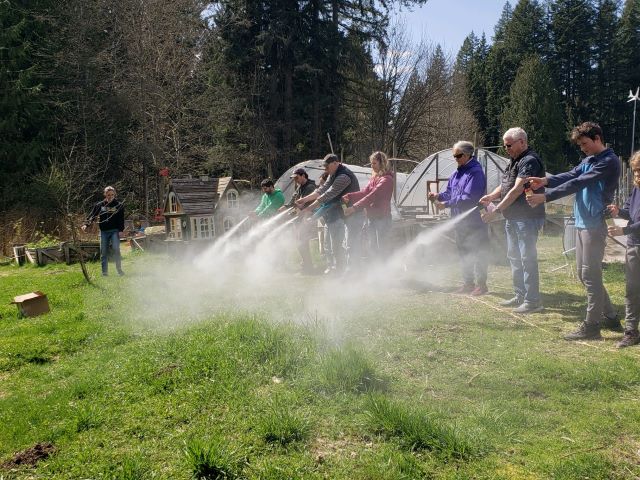
After learning about minimizing attractants, learning about bear behavior and safety tips for dealing with them, participants went out behind the barn to practice using bear spray. Hanley recommends carrying two bear spray canisters when backpacking because the spray can be exhausted after three bursts of 2-3 second sprays.

Workshop participants line up and deploy practice cans of bear spray, aiming at the ground in front of them to create a wall of spice, versus aiming directly at a bear. Photo credit: Lynn Okita

Workshop attendees appreciated the opportunity to learn a new skill and got to take home a free can of bear spray donated by Counter Assault. They also appreciated learning what to do if bear spray gets in their own eyes as well.

Water, Air, and Time were the three first aid words to remember.

Rinse with water and don’t rub your eyes since the grains of capsaicin can aggravate the eye if rubbed. Allow your eyes to use tears to move the spray out. Keep them open and exposed to the air. In time the discomfort will pass, only lasting for 30 minutes or so.

All of this is a better alternative than a bear attack, which Hanley again mentioned is very rare. Even with her vast experiences in the wilderness she has never had to use bear spray. However, it does provide peace of mind.

To learn more about Bear Identification and Bear Safety, visit these links here on the Western Wildlife Outreach website and join this group of newly empowered community members in promoting awareness and peaceful coexistence with our wild animal neighbors.

Turning Fear of Wildlife into Something Positive

Reprinted from THE FREE PRESS
PHIL MCLACHLAN
Fri Jun 16th, 2017

Editors Note: Western Wildlife Outreach has long been warning mountain bike enthusiasts about the need for caution when riding back country trails in bear and/or cougar country. The “need for speed” puts you at greater risk for coming into accidental contact with a large carnivore and surprising them. Surprised animals can react defensively and unpredictably to protect themselves or offspring. Slow it down, and carry bear spray.

WildsafeBC Community Coordinator, Kathy Murray’s journey toward becoming a wildlife expert was inspired by a close encounter with a grizzly bear in Banff National Park, 19 years ago.

On an evening bike ride through the Pipestone Loop Trail, Murray rounded a corner and came face to face with a grizzly sow and her cubs. The bear bluff charged her, stopping three feet in front of her face, with nothing by the bike held in front of her to separate them. The bears dodged around her, and Murray escaped with no injury. This encounter terrified Murray, and deflated her ambition to hike or bike anymore.

Refusing to let fear overcome her love for the outdoors, Murray set out to learn about how humans can coexist with some of natures largest and most fearsome animals.

“I decided to take that fear and turn it into something positive,” she said.

So far this year, there have been many bear sightings, the latest being this past Monday on 4th avenue. Also recently, there was a grizzly spotted on Old Stumpy Trail, and up by the power lines near the Mt. Proctor trails. Murray knows that the summer will soon bring with it lots of people focused on recreating.

“It’s really up to all of us, to be responsible, share the habitat, share the trails,” she said.

The reason for the many bear sightings is due to our heavy snowfall, and cold spring. With little food for the bears in the alpine, they are being forced into the valley bottoms to feed.

Murray believes we can expect to see bears in lower areas for a few more weeks, until the higher areas start to green up.

“People in general have to have a better understanding of bear behaviour,” said Murray. “And a better tolerance, so that we can peacefully co-exist.”

Murray reiterated that it’s extremely important to keep garbage indoors.

“Once bears get a taste of human garbage, human food, and lose their fear of people, it’s pretty much impossible to reverse the process,” she said. “Garbage to bears is like heroin to a crack addict.”

If this happens, the bear becomes what biologists consider a ‘problem’ bear, that we (the public) created.

A grizzly found in town close to a month ago, was relocated 15 kilometres out. The hope is that the bear will become comfortable in their new home, learn to feed and stay put. However this grizzly found its way back to town very soon after.

There are currently several biologists working in the Elk Valley, studying the way grizzly bears use the landscape in the Elk Valley and how they interact with people. They plan on having radio collars on ten sample grizzly bears, in order to track them and gain a better understanding of their activities.

Biologists have been conducting similar studies in the flathead for the past 36 years.

The grizzly which returned to Fernie does have a radio collar, and biologist are monitoring her behaviour. She has not been back after being relocated again.

A previous method of removing bears from an area was translocation, which took bears far away. However even if they were taken hundreds of kilometres away, the bears almost always found their way back again, or they become problem animals in another community.

Murray believes relocation and translocation, “…are not solutions.”

“The best way to keep people safe, prevent human wildlife conflict, and the needless destruction of bears, is to not bait them into the communities in the first place,” said Murray.

With many newcomers in town, Murray believes it is up to the old-time residents to lead by example, keep their garbage locked up, clean up their fruit trees and bring in their bird feeders.

If an individual does not have access to a carport or garage in which to store their garbage between collection days, Murray encourages the use of the 24/7 bear resistant communal bins found at the Fernie Memorial Arena, the Aquatic Centre, and Max Turyk Community Centre.

Since her arrival in Fernie in 2000, Murray has seen a massive increase in trail usage. She believe the high speed and quiet travels puts mountain bikers at risk of animal encounters. When approaching a blind corner, yell or call out, and always carry bear spray.

Murray will be running several sessions throughout the summer, teaching individuals how to properly deploy bear spray. She is currently teaching people at several businesses and schools in the area.

Western Wildlife Outreach Attends Black Bear Release

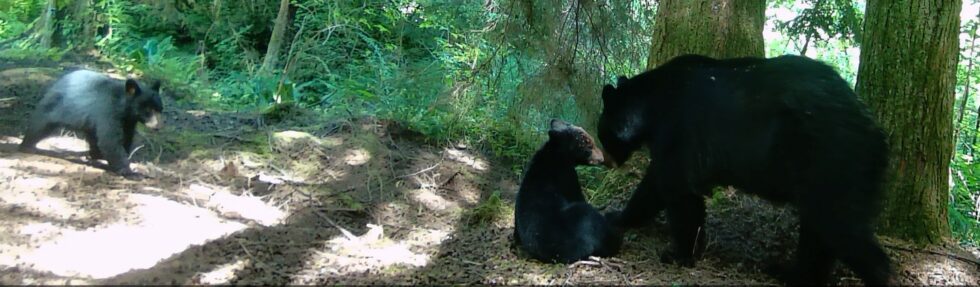
This week Western Wildlife Outreach staff accompanied Washington Department of Fish and Wildlife Enforcement Officers and the Karelian Bear Dog Team into the field to release four black bear cubs.  A shout out to the folks at PAWS in Lynnwood, WA who do such great work with black bear rehabilitation and making this day possible. And a huge WWOOF! to WDFW’s KBD Team, human and canine!

Rivers, Salmon, Bears and Healthy Forests

What if I told you that the trees are here, in part, because of the salmon? That the trees that shelter and feed the fish, that help build the fish, are themselves built by the fish?” ~ Carl Safina, essayist for Salmon in the Trees

Under the cover of darkness, black bears prowl the banks of the stream, wading out among moss-covered rocks below overhanging branches festooned with drooping lichen. The bears are waiting for the return of their favorite feast, spawning salmon. The salmon are returning guided by mysterious forces that have inexorably drawn them from their ocean home back to the streams where they were born and where they will spawn and die, completing the circle of life. But there is a bigger story that goes beyond the salmon, the river and the bears. It’s a story about the intricate connection between the towering conifer giants of the temperate west-coast rainforests, the hungry bears and the returning salmon.

While it might seem somewhat intuitive that the nutrients and nitrogen provided by salmon are beneficial to aquatic plants and plants growing on the stream banks, it has only been in the last decade that the critical role played by bears, both black bears and grizzlies, in dispersing nutrients from salmon throughout the riparian forest has been identified and recognized as an essential component in maintaining the health of riparian forests.

Beginning with early studies by Tom Reichman in 2000, and continued by Gende, Quinn and other prominent researchers, primarily in British Columbia and Alaska, the ultimate “fate” of salmon carcasses removed from the river by bears has been tracked. One such study examined the transport of the salmon into the forests in three watersheds in Southeastern Alaska over three seasons using tagged sockeye salmon and the ultimate location of the recovered tags to tell the story. The results were surprising: up to 50% of the fish caught and killed by bears, both brown bear and black bear, were transported away from the streams and into the surrounding temperate rainforest. Once the bears have successfully landed a protein-rich fish, they often disappear with the prize deep into the trees in order to avoid competition from other bears or scavengers. Once there, the remains of the fish are scattered through the forest,  along with bear scat.

And now the story really gets interesting. Following up on this initial research regarding nutrient transport into forests, a team of researchers headed up by James Helfield and Robert Naiman of the University of Washington’s College of Forest Resources devised a method to measure the actual amount of marine-derived nitrogen in trees through coring the trees and examining the stable nitrogen isotope ratios of annual growth rings.

Nitrogen availability has been identified as the limiting factor for terrestrial plant growth in riparian ecosystems. The study concluded that trees and shrubs near spawning streams grew three times faster than other control stands, and that salmon-borne, marine-derived nitrogen is the reason why. As riparian forests affect the quality of in-stream habitat through shading, sediment and nutrient filtration, and production of large woody debris (LWD), this fertilization process serves not only to enhance riparian production, but may also act as a positive feedback mechanism by which salmon- borne nutrients improve spawning and rearing habitat for subsequent salmon generations and maintain the long-term productivity of river corridors along the Pacific coast of North America.  And all of this marine-derived nitrogen from salmon is transported and made available to the trees by bears!  

Over millenia bears have been fulfilling this age-old critical role of salmon carcass dispersers, moving nutrients from the stream to the forest, so that riparian trees grow tall and strong, eventually contributing large woody debris to streams, improving spawning and rearing habitat for subsequent salmon generations and maintaining the long-term productivity of river corridors along the Pacific Coast of North America. Its time to give bears there due in the watersheds of the Pacific Northwest as the real kings of the forest.

Bears Are Outsmarting Us, and It Might Kill Them

By CANDICE GAUKEL ANDREWS Reprinted  with permission from the author


We all love our national parks. They are our places of solace and refuge; of natural beauty and outdoor adventure. They afford us the chance to get close to what’s left of what is still wild. Of course, there is an inherent conflict in that. Once we have gotten close to “what is still wild,” we change it forever. That has never been truer than it is with bears. Bears are smart and they learn quickly, and what they’re picking up from contact with us could kill them.

Just two years ago, in the summer of 2013, a female black bear in an area just northeast of Yosemite Valley demonstrated her impressive abilities in cracking open bear canisters, a human invention that is supposedly “bear-proof.” Although no one has seen her in action, apparently she didn’t paw or chew on the containers, as other bears have done in the past. At a campsite where the canisters, filled with food, had been stashed near ground level, she went in at night and moved them to a nearby, 400-foot-high ledge. She then pushed the canisters off it and promptly scrambled down to the cliff’s base to retrieve the goodies.Park personnel had never come across anything like this before. It appears bears are keeping abreast of our innovations to thwart them. And in the end, it will probably kill them.

IMG_7454ja_Web
Today, it’s estimated that there are about 30,000 wild black bears in California.(Editors Note: Washington State has between 20-22,000 black bears and shares some of these same bear/human conflicts) In Yosemite National Park, there could be 300 to 500 black bears. If other bears were to start mimicking the Yosemite Valley female’s behavior, the state’s (and all states’) entire backcountry camping system—a key element of which is bear-proof food canisters—could be undermined. Bears are intelligent, and if one bear picked up that behavior, another could soon follow. It would create a free-for-all on backpackers’ food supplies and would almost certainly lead to bear-human interactions and conflicts.  Because park staffers can’t let that happen, last year they caught the clever bear and placed a GPS collar on her in order to track her movements. They set up extra patrols to haze her and to instruct campers to keep far away from the ledge. The incidents stopped in 2014, but this summer the bear started swiping canisters in the same area again. The park’s wildlife management department may have to pursue more drastic measures: banning campsites in the vicinity of the ledge altogether or euthanizing the bear.

Last August, in a study conducted at the Washington State University (WSU) Bear Research, Education and Conservation Center, eight grizzly bears were tested to see if they could use tools. In an experiment designed by student Alex Waroff, grizzly bears were enticed with a glazed doughnut dangling just out of their reach in their play area on the WSU campus. The researchers place a sawed-off tree stump below the hanging doughnut (which is not part of their normal diet) to see if the bears would use it to stand on to reach the treat. If they did that, then the stump would be turned on its side and moved away to see whether the bears would move it back under the gooey confection.  The study team hopes that this research will help us understand how bears think and that then we can anticipate their moves and alter our practices in the backcountry to keep us and the bears safe—mostly from us.

In the end, the Yosemite bear’s behavior is a reflection of our own. One mistake from one careless camper is all it takes to endanger a smart bear. In reality, as it’s often been said, wildlife management is 95 percent human management.  When animals outsmart us, should they be the ones to suffer? Since it is most often humans who make “problem bears,” should we be the ones that are hazed out of bear areas? Is euthanizing a bear ever the best solution?

Photo 1 ©Candice Gaukel Andrews, Photo 2 ©John T. Andrews, Photo 3 ©Justin R. Gibson

Originally published at http://goodnature.nathab.com/bears-are-outsmarting-us-and-it-might-kill-them/